Total Pageviews

Showing posts with label deflation. Show all posts

Wednesday, 20 May 2015

Unit 4: Deflation in the UK!

A timely piece of news came out of the UK yesterday.

Click here for the article on the latest inflation figures.

Some very useful analysis from the economics editors at the BBC.

Please try and read today so we can discuss in the lesson.


Thursday, 15 January 2015

Unit 2 & 4: Why is low inflation a bad thing?

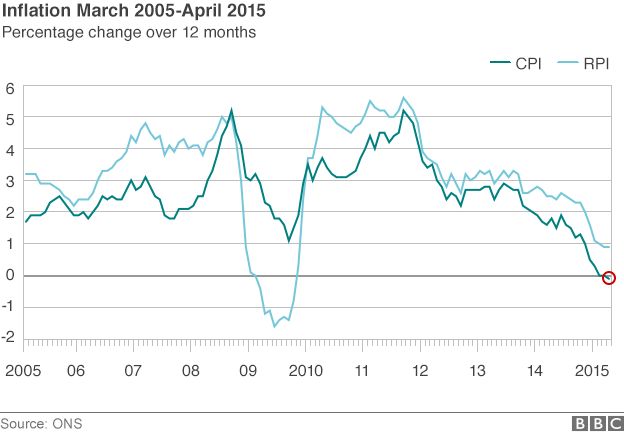
CPI inflation has slipped well below the lower limit of the Monetary Policy Committee's target, to 0.5% - that is far lower than it fell during the recession, and the lowest level since May 2000. So, as Mark Carney prepares his letter to the Chancellor to explain how this has happened, and what the Bank of England intend to do about it, the BBC have published an article which examines why we need some inflation. It is one of those articles which is truly useful - probably more so than a text book as it is based on real, current context. 

Highly recommended to AS students learning about inflation for the first time, and A2 students who need to revise the basics. 

Robert Peston takes this a bit further, in a blog which A2 students should certainly read, as it examines the risk of deflation, and whether 'benign' price falls in food and fuel might become 'growth-killing' deflation. Again, it is textbook stuff which is happening in real-time, and really useful background for students. 


We have to wait to see Mark Carney's letter to the Chancellor, which will be published by the Bank of England alongside the February Inflation Report on 11 February. 

However, in the meantime,  ITV's Economics Editor Richard Edgar has his own ideas of what it may look like -drafting Mark Carney's letter could be a tempting exercise for prep, this week!

Unit 2 & 4: UK Inflation falls to 0.5%

Recent inflation figures in the UK were released yesterday. Click here to read the article. It raises many questions.

How can the government solve this issue?
What would happen if the economy had deflation?

Excellent for both Unit 2 & 4.

Thursday, 8 January 2015

Unit 4: Deflation in Eurozone countries

There is so much going oin in the world of economics at the moment. Latest figures show that the Eurozone, as predicted, now has deflation. 

The tip into deflation adds pressure on the European Central Bank (ECB) to take further action to stimulate the bloc's economy.

Click here for the BBC article.


Saturday, 3 January 2015

Unit 2 & 4: Monetary Policy in the Eurozone.


Draghi comments send Euro to lowest level since 2010


Click here to read an interesting article regarding monetary policy in the Eurozone. There is lots in it for macro economics students.

Not least:

Monetary Policy
Quantitive easing
Exchange Rate
Deflation

Make sure you understand the link between all of the above concepts. Please discuss with your teacher.

Friday, 2 March 2012

Unit 4: Deflation in the EU

A predictable, but nevertheless depressing, event is to see Europe slipping into deflation.

Monthly inflation in the EU area was -0.8% in January 2012. (EU Stat) The 12 month inflation figure was 2.6%, which includes some cost-push inflation. Inflation will continue to fall over the coming months However, there are few signs of economic recovery. Countries in the periphery of the EU are at greater risk of deflation because of the continued austerity, high exchange rate and fall in economic confidence. The ECB has been debating whether to pursue quantitative easing, but there is a deep-seated reluctance to pursue this unorthodox monetary policy.

The problem is that even quantitative easing can take a long time to have an effect on economic activity. The experience of the UK and US is hard to judge, but it has had an effect in preventing a deeper and longer lasting recession. Any fears of inflation resulting from quantitative easing seem hard to justify as the economies struggle along.

A short reminder of the timeline of the current economic crisis

How Will Deflation Affect the Eurozone?
  • Increase Debt to GDP ratios. Falling nominal GDP will increase the debt to GDP ratio. Even if countries like Greece and Portugal manage a primary budget surplus (which is very hard to imagine), they would still see rising debt to GDP ratios, and probably a continuation of higher bond yields
  • Decline in consumer Spending. Deflation plays a key role in delaying spending decisions. Faced with falling prices, people tend to delay spending, waiting for goods to become cheaper.
  • Higher real Interest Rates. With deflation, real interest rates are effectively higher.
  • Higher unemployment. With continued deflation and lower growth, EU unemployment will remain high.
  • More on economic costs of deflation.