Showing posts with label currency. Show all posts
Showing posts with label currency. Show all posts
Sunday, 11 June 2017


Thursday, 25 May 2017
Tuesday, 8 November 2016
Theme 2 & 4: Egypt's currency falls by over 50%
In recent times, Egypt have switched between floating and fixed exchange rates for its currency - the pound. After the Arab Spring of 2011 it reimposed controls and only now has decided to revert to a floating exchange rate, with the effect that it fell 48% immediately and has continued to fall in subsequent days.
The key reason for the decision to move to a floating rate seems to be because they want a large loan ($12billion) from the IMF and won't get it without making the change! According to the IMF, "The flexible exchange rate regime... will improve Egypt's external competitiveness, support exports and tourism and attract foreign investment, all of this will help foster growth, job creation and stronger external position for the country."
Of course, the cost of imports will now increase significantly which will cause some short-term pain for Egyptian consumers and businesses that need to import machinery etc.
Students may themselves be thinking how all of this could affect them so it might be a good time to ask if a) anyone has been to Egypt (perhaps unlikely, depending on where you are) or b) anyone wants to go to Egypt at some point in their life. An interesting digression can then be made into why you might want to go to Egypt, what other "bucket list" items you might have and bringing it all back to the effect of exchange rates on the cost :)
The article can be found here.
Thursday, 8 January 2015
Unit 2 & 4: More data on Russia - excellent application to theory
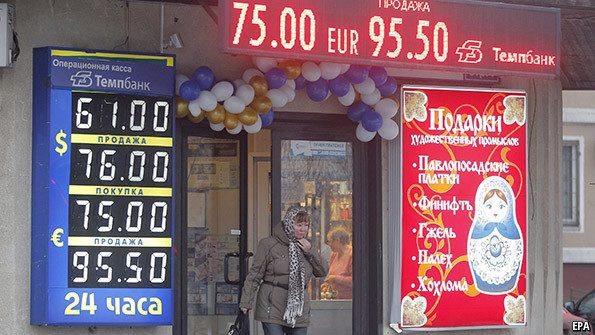
The recession and currency crisis in Russia provides plenty of material for both AS and A2 students to get their teeth stuck into.
AS students could consider the inflationary effects of the plummeting rouble. With inflation at 9.1% and "Russian shopkeepers re-pricing their goods daily" it provides an excellent real world example of what is often referred to in textbooks as menu-costs.
With the rouble depreciation nearly 50% against the dollar in a matter of weeks it is also a useful example of imported inflation, pushing food price inflation to over 30%, which is eroding the living standards of the majority of working Russians.
A2 students could look at the attempts of the central bank to defend the currency. A 6.5 percentage point increase at 1am on the 16th December took the interest rate to 17%, a 12.5 point increase from the start of the year.
Russia has also spent some $80bn dollars in 2014 defending the value of the currency.
The initial effects of he rate rise was indeed to strengthen the rouble but the gains were eroded and reversed by the end of the day. Lots of interesting discussions to be had about what drives currency movements.
There is also plenty of discussion about Russia's debt, both dollar-denominated and rouble-denominated. The ability of Russia pay back $115bn of dollar debt which is due in 2015 is increasingly being called into questions as the rouble depreciates.
This is obviously not just a Russian specific issue, the elections in Greece and the potential 'Grexit' could put Greece's euro-denominated debts under huge pressure.
All this is without even mentioning oil prices. Brent crude oil traded at $50 yesterday, a fresh low.
Tuesday, 11 March 2014
Unit 4: Weak currency increases trade deficit in Japan
I read an interesting article in 7 Days this morning about Japan's current account deficit. It highlights the issue of a weak currency actually contributing to a larger trade deficit. Click here for a bloomberg news article on the subject. (Excellent evaluative article on currency and trade deficit)
Q) Why would a weak currency make a trade deficit worse?
I welcome any comments.
Q) Why would a weak currency make a trade deficit worse?
I welcome any comments.
Subscribe to:
Posts (Atom)