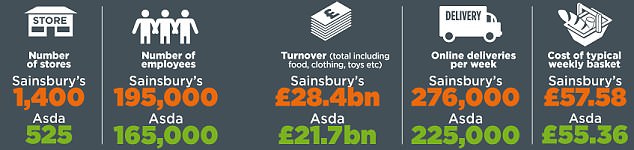
Click on this link to read an excellent and timely piece on the proposed merger between Sainsbury's and Asda, two huger supermarkets in the UK.
There is so much Economics in this article. Points to discuss:
What is the view of the CMA?
What are the opposing arguments given by the Supermarkets involved?
Who is correct?
Is the market contestable?
What would the positives have been for the consumer if this merger went ahead?
What would the impact of the merger have been on efficiency?
I don't think anybody has any idea what the economic impact of Brexit will be. Steve Eisman
Total Pageviews
Showing posts with label mergers. Show all posts
Thursday, 25 April 2019
Wednesday, 26 October 2016
Theme 3: Mergers, market power and efficiency
Nice article to read on the impact of takeovers and mergers on economic efficiency and consumer welfare.
Drawing on research on the US economy, a report finds that corporate integration accelerates the process towards oligopolistic markets which can lead to higher prices in the long run.
"Bruce Blonigen and Justin Pierce of the Federal Reserve Board have some evidence. In a new paper titled “Evidence for the Effects of Mergers on Market Power and Efficiency,” they look at how mergers in manufacturing affect corporate performance. What they discovered is that mergers usually tend to increase market power -- in other words, they allow companies to increase profits by hiking prices. But they don’t find much evidence for improved efficiency."
Salmaan, let the class know what you think!
Monday, 27 June 2016
Unit 3: Why many mergers/takeovers fail!
Many mergers and takeovers between businesses fail to achieve the expected revenue and cost gains for shareholders. This short revision video looks at some of the key reasons.
Tuesday, 9 February 2016
Unit 3: The UK Mobile Phone operators & regulation
Click here to access an article found by Arjun about the UK mobile phone industry. Excellent when discussing the advantages of competition, issues with mergers and effectiveness of government regulation.
Labels:
government regulation,
mergers,
mobile phone,
oligopoly
Saturday, 21 November 2015
Unit 3: Mergers, de-mergers & acquisitions in the news
Lots of action in the business markets at the moment. Please take some time to look at these. we will discuss in the lessons this week.
Saturday, 31 October 2015
Unit 3: Mergers and Acquisitions in the News
Takeover of Morrisons
Are big mergers bad for consumers?
Poundland and 99p Stores
Shell buys BG group
Southwest Water and Bournemouth merge
Beer Giants merge
Thursday, 15 May 2014
Unit 3: Another merger in the news - Dixons & Carphone Warehouse
Click here for the latest on the merger between Dixons and Carphone Warehouse. Not only does it raise some excellent points on the advantages of merging, but take some time to read the analysis from Kamal Ahmed on the right hand side.
It highlights the previous issues that Carphone Warehouse had when it merged with the American company 'Best Buy'. (ie, 'they completely misunderstood the shopping habits of the British customer')
Possible questions:
Q) What type of merger is this? (4 Marks)
Q) Assess the advantages to the consumer & the producer of this merger. (12 Marks)
Q) What are the potential issues with a merger of this kind, in this market at this time? (12 Marks)
It highlights the previous issues that Carphone Warehouse had when it merged with the American company 'Best Buy'. (ie, 'they completely misunderstood the shopping habits of the British customer')
Possible questions:
Q) What type of merger is this? (4 Marks)
Q) Assess the advantages to the consumer & the producer of this merger. (12 Marks)
Q) What are the potential issues with a merger of this kind, in this market at this time? (12 Marks)
Sunday, 4 November 2012
Unit 3: Mergers, acquisitions & regulators.
Thanks to Gabriele for finding this excellent article on market structures and the difficulties regulators face when making decisions.....
THIS year has seen the demise of a Brazilian oddity: an antitrust regime that allowed companies to merge first and the regulator to ask questions only later. Under an unlamented system laid to rest in June, studies of market dominance were carried out after mergers and acquisitions had taken place—and not once, but thrice. First the finance ministry, then the justice ministry and finally CADE, the competition regulator, would ponder before a decision was reached. “Companies could bet on the process being so slow that if a decision went against them, they could go to court and argue that unpicking the deal was now impossible,” says Tatiana Farina of Insper, a São Paulo business school.
The three regulators have now been rolled into one, promptly nicknamed “Super CADE”. Deals that could lead to consumer-harming market concentration require prior permission. If in the previous year one firm had sales in Brazil of more than 400m reais ($198m) and the other sales above 30m reais, any deal now needs the regulator’s approval.
The new CADE is modelled on antitrust regulators in the United States—with one notable difference. It has far longer to issue its ruling: 330 days instead of 30. Fear of delay led companies to rush through around 140 deals in the weeks before the switchover in June. But so far, the new CADE has beaten its leisurely deadline, says Fabíola Cammarota of Souza, Cescon, Barrieu & Flesch, a law firm. The firm has received pre-merger decisions in less than three weeks on simple cases; a complex case it submitted in July is progressing smartly.
The old CADE fell into disrepute over Nestlé’s purchase in 2002 of Garoto, a Brazilian chocolatier, giving it well over half of the chocolate market. CADE ruled that the deal should be unpicked—two years later. By then Garoto had been swallowed. Nestlé has been fighting the decision in the courts ever since. The deal may now be referred back to CADE.
Such interminable cases used to crowd out investigations into suspected cartels. Now CADE should have more time for these, and it has fiercer weapons as well. They include stiffer penalties—managers guilty of market-rigging are now more likely to go to jail—and the power to offer plea-bargains to whistle-blowers.
Pre-merger approval should help to protect Brazilian consumers from their politicians’ fondness for creating national champions. When the merger of the two dominant brewers in the 1990s created a giant with 70% of Brazil’s beer market, the government said it wanted many more such deals in other sectors, and promised that BNDES, the national development bank, would help with loans. Creating giants able to compete globally mattered more than healthy competition at home. That may now change.
You can add to the blog if possible, some interesting points I found are: (some are evaluation points)
1. Efficiency of regulators. How much time it takes for the regulators to make its decision: 330 days Brazil (very slow) vs 30 days USA
2. How stiff are the penalties for colluding?
3. Power of plea bargain to whistle-blowers (similar situation to the Prisoner's dilemma)
4. Trade off between allowing large firms to emerge in order to compete internationally vs healthy competition at home
THIS year has seen the demise of a Brazilian oddity: an antitrust regime that allowed companies to merge first and the regulator to ask questions only later. Under an unlamented system laid to rest in June, studies of market dominance were carried out after mergers and acquisitions had taken place—and not once, but thrice. First the finance ministry, then the justice ministry and finally CADE, the competition regulator, would ponder before a decision was reached. “Companies could bet on the process being so slow that if a decision went against them, they could go to court and argue that unpicking the deal was now impossible,” says Tatiana Farina of Insper, a São Paulo business school.
The three regulators have now been rolled into one, promptly nicknamed “Super CADE”. Deals that could lead to consumer-harming market concentration require prior permission. If in the previous year one firm had sales in Brazil of more than 400m reais ($198m) and the other sales above 30m reais, any deal now needs the regulator’s approval.
The new CADE is modelled on antitrust regulators in the United States—with one notable difference. It has far longer to issue its ruling: 330 days instead of 30. Fear of delay led companies to rush through around 140 deals in the weeks before the switchover in June. But so far, the new CADE has beaten its leisurely deadline, says Fabíola Cammarota of Souza, Cescon, Barrieu & Flesch, a law firm. The firm has received pre-merger decisions in less than three weeks on simple cases; a complex case it submitted in July is progressing smartly.
The old CADE fell into disrepute over Nestlé’s purchase in 2002 of Garoto, a Brazilian chocolatier, giving it well over half of the chocolate market. CADE ruled that the deal should be unpicked—two years later. By then Garoto had been swallowed. Nestlé has been fighting the decision in the courts ever since. The deal may now be referred back to CADE.
Such interminable cases used to crowd out investigations into suspected cartels. Now CADE should have more time for these, and it has fiercer weapons as well. They include stiffer penalties—managers guilty of market-rigging are now more likely to go to jail—and the power to offer plea-bargains to whistle-blowers.
Pre-merger approval should help to protect Brazilian consumers from their politicians’ fondness for creating national champions. When the merger of the two dominant brewers in the 1990s created a giant with 70% of Brazil’s beer market, the government said it wanted many more such deals in other sectors, and promised that BNDES, the national development bank, would help with loans. Creating giants able to compete globally mattered more than healthy competition at home. That may now change.
You can add to the blog if possible, some interesting points I found are: (some are evaluation points)
1. Efficiency of regulators. How much time it takes for the regulators to make its decision: 330 days Brazil (very slow) vs 30 days USA
2. How stiff are the penalties for colluding?
3. Power of plea bargain to whistle-blowers (similar situation to the Prisoner's dilemma)
4. Trade off between allowing large firms to emerge in order to compete internationally vs healthy competition at home
Tuesday, 6 March 2012
Unit 3: Mergers in action
A fabulous example of some of the challenges and potential problems that arise when a merger of two substantial, similar businesses is finally completed…
This short news clip highlights the nature of the change facing management and employees working to merge United Airlines and Continental Airlines as the final stage of the merger - a transfer of booking systems - took place.
Subscribe to:
Posts (Atom)
