Total Pageviews

Showing posts with label government regulation. Show all posts

Wednesday, 9 January 2019

Competition Policy 2019

Why does the government intervene in markets to maintain competition?
Students should be able to:
  • Explain and evaluate measures aimed at enhancing competition between firms and their impact on prices, output and market structure.
  • Compare and evaluate the strengths and weaknesses of methods of regulation for example price capping, monitoring of prices and performance targets.


Competition Policy In Action from tutor2u


Paper 3 - June 15 (old spec, but essays require same process)

09        Explain how the determination of prices & output by oligopolists is affected not only by the reactions of their customers, but also by their interdependence with other producers.
(15 Marks)

10        The European commission prevents mobile phone networks from colluding on ‘roaming charges’ when consumers travel around Europe. Meanwhile, the EU has forced mobile phone manufacturers to cooperate in making a single design of a phone charger.
Evaluate the view that governments should never intervene to influence how oligopolists collude or cooperate on such issues as fixing prices, varying output, conducting research, developing products, or carrying out any other aspect of their business.
(25 Marks)

Thursday, 15 November 2018

Regulations (Government Intervention)

Regulations are a form of government intervention in markets - there are many examples we can use:


Examples include:
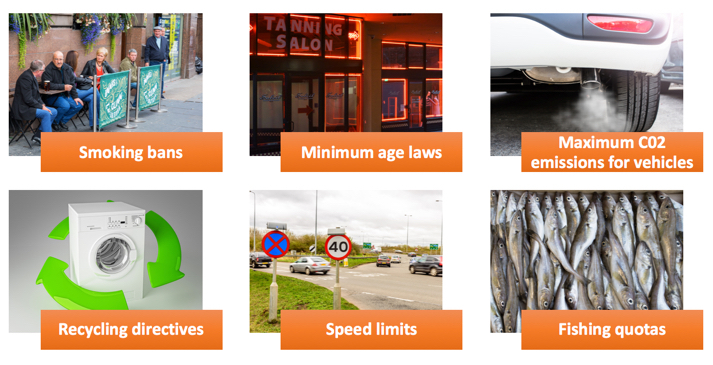
  • Laws on minimum age for buying cigarettes and alcohol
  • The Competition Act which penalizes businesses found guilty of price fixing cartels
  • Statutory national minimum wage
  • A new law in Scotland banning under-18s from using sun-beds
  • Equal Pay Act and acts preventing other forms of discrimination
  • Changes in the law on cannabis
  • Maximum CO2 emissions for new vehicles, laws which restrict flight times at night
  • Government appointed utility regulators who may impose price controls on privatized monopolists e.g. telecommunications, the water industry
The economy operates with a huge and growing amount of regulation. The government appointed regulators who can impose price controls in most of the main utilities such as telecommunications, electricity, gas and rail transport.
Free market economists criticize the scale of regulation in the economy arguing that it creates an unnecessary burden of costs for businesses – with a huge amount of "red tape" damaging the competitiveness of businesses.
Regulation may be used to introduce fresh competition into a market – for example breaking up the existing monopoly power of a service provider. A good example of this is the attempt to introduce more competition for British Telecom. This is known as market liberalization.
Problems that regulators of markets / industries can face
  1. Hard to find evidence of anti-competitive behaviour:
    • Lack of spoken or written evidence
    • Conflicting or asymmetric information
    • Complex information
    • Conflicting evidence – e.g. it might be markets forces or collusion in an oligopoly
  2. Fear of fines or other control mean that there is strong incentive to conceal collusion
  3. Lack of regulator power and lack of regulator resources

Revision Video: Evaluating Government Intervention in Markets


Wednesday, 31 October 2018

Regulation, Government Failure - Price Capping & ineffective regulation

This is a big topic these days. Governments try to intervene in markets in many ways, sometimes with success, others causing bigger issues. Below is a few presentations, videos, notes on the topic.

We will be going through in class.

Regulation and externalities:


Examples include:
  • Laws on minimum age for buying cigarettes and alcohol
  • The Competition Act which penalizes businesses found guilty of price fixing cartels
  • Statutory national minimum wage
  • A new law in Scotland banning under-18s from using sun-beds
  • Equal Pay Act and acts preventing other forms of discrimination
  • Changes in the law on cannabis
  • Maximum CO2 emissions for new vehicles, laws which restrict flight times at night
  • Government appointed utility regulators who may impose price controls on privatized monopolists e.g. telecommunications, the water industry (see later)
Regulation and Monopoly

The main aims of competition policy are to promote competition; make markets work better and contribute towards improved efficiency in individual markets and enhanced competitiveness of UK businesses within the European Union (EU) single market.
Competition policy aims to ensure
  • Technological innovation which promotes dynamic efficiency in different markets
  • Effective price competition between suppliers
  • Safeguard and promote the interests of consumers through increased choice and lower price levels


There are four key pillars of competition policy in the UK and in the European Union
  1. Antitrust & cartels: This involves the elimination of agreements that restrict competition including price-fixing and other abuses by firms who hold a dominant market position (defined as having a market share in excess of forty per cent)
  2. Market liberalisation: Liberalisation involves introducing competition in previously monopolistic sectors such as energy supply, retail banking, postal services, mobile telecommunications and air transport
  3. State aid control: Competition policy analyses state aid measures such as airline subsidies to ensure that such measures do not distort the level of competition in the Single Market
  4. Merger control: This involves the investigation of mergers and take-overs between firms (e.g. a merger between two large groups which would result in their dominating the market)
Main Roles of the Regulators
  • Regulators are the rule-enforcers and they are appointed by the government to oversee how a market works and the outcomes that result for producers and consumers
  • The main competition regulator in the UK is the Competition and Markets Authority (CMA)
Examples of competition policy in action
  • De-regulation - laws to reduce monopoly power
    • Preventing mergers/acquisitions that create a monopoly
    • Laws to introduce competition into the postal services industry
    • Forced sales of assets e.g. BAA and airports in the UK
  • Privatisation - transferring ownership
    • Stock market floatation of the Royal Mail
    • Part-privatisation of Network Rail similar to the sell-off of HS1 - the high-speed link that connects London's St Pancras to the Channel tunnel, on a long-term concession
  • Tough laws on anti-competitive behaviour
    • Strong laws and penalties against proven cases of price fixing or collusion that involves market sharing
    • Companies breaching EU and UK competition rules risk hefty fines of up to 10 per cent of global turnover - senior executives can be jailed
  • Reductions in import controls
    • A reduction in import tariffs encourages cheaper products from overseas
    • Increasing or eliminating import quotas can also have the same effect
    • Allowing new countries into the European Union single market increases contestability
  • Price controls: The government appointed regulators can also impose price capping formula in most of the main utilities such as telecommunications, electricity, gas and rail transport. (this is due to natural monopoly element of these industries)

Regulation may be used to introduce fresh competition into a market – for example breaking up the existing monopoly power of a service provider. A good example of this is the attempt to introduce more competition for British Telecom. This is known as market liberalization.


Free market economists criticize the scale of regulation in the economy arguing that it creates an unnecessary burden of costs for businesses – with a huge amount of "red tape" damaging the competitiveness of businesses.


Problems that regulators of markets / industries can face
  1. Hard to find evidence of anti-competitive behaviour:
    • Lack of spoken or written evidence
    • Conflicting or asymmetric information
    • Complex information
    • Conflicting evidence – e.g. it might be markets forces or collusion in an oligopoly
  2. Fear of fines or other control mean that there is strong incentive to conceal collusion
  3. Lack of regulator power and lack of regulator resources

Tuesday, 23 January 2018

Government regulator blocks Fox takeover of Sky.

A timely intervention by the government regulator. Fox's proposed takeover of Sky is not in the public interest on grounds of media plurality, the UK's Competition and Markets Authority (CMA) has said.

Click here to read the article.

Useful when discussing effectiveness of government regulation. Again, think about who the winners and losers are in the case, both in short and long run.

Thursday, 3 November 2016

Theme 3: Government regulation

Excellent presentation on the ways governments regulate industry, the reasons behind it, and the advantages and disadvantages of each method.

Sunday, 23 October 2016

Theme 3: AT & T to buy Time/Warner - integration

Click here to access an article discussing the latest major piece of business integration. For once, I actually find myself siding with Donald Trump!

Useful article when looking at horizontal/conglomerate integration. Specifically the potential advantages/disadvantages of the deal for consumers.

The companies say the deal will bring all sorts of good things for the consumer. However, many (including Trump) are suggesting it would make the company far too powerful.

What do you think...........Aruj?

Wednesday, 31 August 2016

Unit 3: Should we re-nationalise the trains?

This short video from Chris Cook of BBC Newsnight looks at some of the arguments for and against taking train operating services back into state ownership.
Strikes, delays and fare increases are feeding the frustrations of passengers on the railways. Would bringing them back into public ownership bring lower prices and better service?

Tuesday, 9 February 2016

Unit 3: The UK Mobile Phone operators & regulation

Click here to access an article found by Arjun about the UK mobile phone industry. Excellent when discussing the advantages of competition, issues with mergers and effectiveness of government regulation.

Wednesday, 27 January 2016

Unit 3: Tesco abusing its market power?

Tesco "knowingly delayed paying money to suppliers in order to improve its own financial position", the supermarket ombudsman has found. 

Click here for article.

Useful when discussing the market power of monopsonies and the effectiveness of regulators.


Saturday, 9 January 2016

Unit 3: Banking and the regulator - are they effective?

Click here to access an article published in Jan 2016 about the financial regulator (Financial Conduct Authority FCA).

In it, the interim chief executive of the Financial Conduct Authority has defended her record in regulating the banking sector. Useful for application & evaluation on the quality and effectiveness of the government regulators.

Thursday, 10 December 2015

Unit 3: Rail Franchise - Contestability & government regulation

I recently read this article from my local towns newspaper. It talk about how the new rail company that will operate the second largest franchise in the UK, the promises it makes and how the consumer will be better off as a result.

Excellent context for any question on government regulation, natural monopolies and contestability.

Thursday, 23 April 2015

Unit 3: Supermarkets investigated by the CMA

Thank you to Luke for this excellent article on supermarkets. The competition regulator is to scrutinise allegations that UK supermarkets have duped shoppers out of hundreds of millions of pounds through misleading pricing tactics.

A classic example of powerful firms exploiting the consumers lack of knowledge (asymmetric information).

Take time to look at what the CMA intends to do about it. It highlights to me one of the evaluative points you can make about regulations....it takes forever! In the meantime, the supermarkets can go on exploiting consumers, or decide not to whilst the investigation is ongoing, therefore avoiding fines, leaving them open to continue exploitation in the future!

The article also highlights the issue of monopsony power in the supermarket industry, with 1400 suppliers facing bankrupcy!


Monday, 9 March 2015

Unit 3 & 4: Govt Regulation and falling oil price issues

Thank you to Elliot for this article on the Venezuelan food crisis. Plenty of food for thought (sorry for the pun).

Firstly, the government in Venezuela offers food at artificially low prices with the aim of helping the poor. However, one problem with maximum prices is that it creates excess demand. Long queues and food shortages are reminiscent of the old Soviet Union. In addition, it seems that some unscrupulous food smugglers are buying the cheap food to sell at a profit in Colombia.

On top of this issue is the fact that falling oil revenues and a depreciating currency mean it is proving expensive for Venezuela to import the food they are trying to sell so cheap!

Primary product dependency, Prebisch-Singer Hypothesis, government regulatory failure are all in this article.


Wednesday, 18 February 2015

Unit 3: CMA & Report on the 'Big Six'!

Morning everyone, thanks again to Riz for sending me this article on the gas companies. It seems that they are charging more for their energy than perhaps they should.

However, the CMA still regards the profits to be within the reasonable limits, despite the fact the energy costs are hitting the 'Most Vulnerable'. Is this an example of regulatory capture?

Tuesday, 10 February 2015

Unit 3: Another great regulation article

Thank you to Riz for finding another great article on regulation. (Click here to access).

The article identifies issues with patents (part of the a question you have just completed in your mock exam!)


Thursday, 5 February 2015

Unit 3: Tesco being investigated - Regulation

Tesco is to face another investigation into its relations with suppliers, amid concerns that it breached the Groceries Supply Code of Practice.    Click here to read the article.

It highlights the issue that a huge company like Tesco can have buying power over smaller suppliers. (monopsony).

This can not only mean pushing prices down, but also withholding payments to suppliers, causing cash flow problems and bankruptcy.

The article suggests that the regulation investigation will take 9 months. Not only is this a huge cost to the taxpayer, but it also means nothing can be done for the suppliers for at least this period of time, if not longer.

Is this another example of government failure as far as regulation is concerned?


Tuesday, 3 February 2015

Unit 3: Gas Prices - Is there 'real' competition?

Thank you to Riz for finding this excellent article on gas prices in the UK.

It raises many important issues for Unit 3 students.

For instance, the big six do face competition from many smaller firms, but it suggests that they are not really effecting the market enough to change behaviour.

Also, the gas industry say they cannot pass on the recent price falls due to the fact they 'hedge' bu buying gas at a 'futures' price rather than the current market price.

Whether this is true and to what extent it effects gas prices for the customer is the regulators role to find out. But it highlights the complex issue of gas pricing and asymmetric information.

Wednesday, 21 January 2015

Unit 3: UK Gas Prices...we said it would happen!

Scottish Power has become the third major gas supplier to announce a price cut, with the news it is to reduce prices by 4.8% from 20 February.  Click here for full article.

Lots of excellent economics for Unit 3, including kinked demand curve theory, regulatory power (have the gas companies gone far enough), oligopoly behaviour etc

Friday, 28 November 2014

Unit 3: Monopoly and regulation - Google

Thanks to Safiyah for this excellent post on monopoly and regulation. Click here for the article from the Economist. It highlights many issues, such as contestability, barriers to entry, restrictive practices, government regulation, on line vs off line......fantastic stuff.

We will discuss this on Sunday/Monday....be ready!

Questions I will be asking will be:

How contestable is this market?
Should the EU be regulating all online monopolies?
How could they regulate them?
What will be the impact on the customer?