Total Pageviews

Showing posts with label model answer. Show all posts

Tuesday, 7 May 2019

Essay Model Answer - Protectionism and current account

Evaluate the significance for the UK balance of payments on the current account of increased use of protectionist policies around the world. (25 Marks)

Protectionist policies are used to prevent the number of imports, and encourage people to purchase domestic goods/services, these include tariffs and quotas. These policies are used to help reduce the deficit a country may have-the UK has a trading deficit, mostly due to the fact it imports more than it exports. They protect domestic industries in several ways; a tariff is a tax places on imported goods and a quota limits the number of imports brought into the country. Protectionist policies also include non-tariff barriers such as rules and regulations with regard to health and safety. The balance of payments on current account is made up of four components; 1) trade in goods 2) trade in services 3) investment income 4) balance transfers. 

Currently the UK has a deficit in the trade of goods (imports-exports). This could be made further if there was an increase in protectionist policies around the world. Exports from the UK is already minimal, if protection policies such as tariffs were put in place it could reduce the number of them even further. This is because the price of UK exports would increase. This means people abroad would no longer buy UK goods and would put domestic businesses that rely on exports at risk.  

However, it is likely the UK would retaliate by placing tariffs on imports coming into the UK. Therefore if the UK was to became more efficient in producing goods, sales would increase heavily domestically. The tariff will also depend on the type of good, if it is inelastic it is unlikely to have any effect e.g. oil. Therefore tariffs may have little effect on the UK's balance of trade.

By placing quotas on exports, the UK would have limit the amount of goods/services exported. Due to the restricted number, it is likely the price for the exported good would increase, which could possibly lead to decreased demand. The UK have a surplus in their trade in services. By limiting the amount, this surplus could deteriorate as less banks for example could set up abroad. This would heavily effect the UK's balance of payments. 

However, as previously said the number of UK exports is already low, therefore quotas may not have a significant impact on the trade of goods. This is because the UK has a deficit as is, and this is NOT due to protectionist policies. This suggests that if protectionist policies were put in place, the UK balance of payments would be mildly effected as they are a predominantly importing country. 

Non-tariff barriers such as administration costs will also effect the UK balance of payments. This will make it difficult for the UK to export goods due to regulations such as health and safety. This could increase there trade deficit as they will be restricted on the amount of exports. The UK will most likely enforce similar laws to imports, this will make trade all together more difficult. If the UK is limited to the number of exports, domestic industries will suffer as they can no longer sell their goods abroad and the only market they access to are the domestic markets. Therefore the trade deficit will worsen.

However non-tariff barriers wont be significant in limiting the number of exports. It is unlikely administration will reduce the amount of exports to have a significant impact on the balance of trade. The Uk is also part of the EU which is their main trading bloc, this means that if other countries use protection policies the UK wont be heavily effected as they will maintain their relationship with the EU. 


Overall, if protectionist policies around the world were to increase it could worsen the UK deficit. This is due to a fall in the level of exports and the inability to set up businesses abroad. However it would depend on how strong the protectionism policies were and if the EU were involved. The fact that the UK doesn't export large amounts suggests that it might a very limited effect on the UK balance of payments of current account. 

Essay model answer - Determinants of demand for imports

This is a 20 mark answer. It could be asked as a 25 marker. You would add one more point to this essay to gain the extra marks.

Assess the main economic determinants of a country's demand for imports (20)


An import is a good or service that has been brought in from abroad. The money from the specific import will go back to the country it came from. Imports are apart of balance of payments, and if imports too high it can ultimately cause a trade deficit.

Income elasticity of demand plays a key role in determining the amount of imports a country will demand. People in the UK are experiencing a period of increasing disposable income, this means they will demand more imports-the richer people feel, the more imports they will buy. Imports are seen to be a of better quality or luxury goods when compared to domestic products, for example wine from France. This is because of the increased choice of products. UK consumers will purchase imports as they are exposed to readily available, higher quality products. Therefore a rise in income will likely result in increased imports.

However, income elasticity of demand may not be as significant. People may choose to save their money rather that purchase expensive imports. Due to the current state of the of the UK people wont have the confidence to 'splash' money around. It is more likely that people will save money, this could therefore decrease the demand of imports.

Comparative advantage is when a lone country as a lower opportunity costs. This means it is more efficient for a country to focus on producing what they have comparative advantage in, and import the good/services that they don't. For example the UK have comparative advantage in pharmaceuticals. This means that countries around the world would demand pharmaceuticals from the UK as they are nest at producing them. Therefore the demand for imports from the UK would increase, as countries were better off importing them rather than producing their own pharmaceuticals.

However, comparative advantage may not work in the long run unless they reinvest. For example, the UK used to have comparative advantage in ships, however they did not reinvest and lost this advantage. The demand for the product may decrease all together. The increasing discoveries of new technology means that the demand of products will fall in specific areas, and therefore imports will decrease.

Finally, countries may lack vital resources such as oil which will lead to an enormous increase in demand for imports. In the UK it impossible for them to produce enough oil to go round. Therefore, as it is an inelastic good, they have no choice but to import.

Overall, countries demand imports for several reasons. Imports on a global scale are increasing due to various factors such as a decrease in protectionist polices. The most significant detriment of a countries demand for imports is due to income elasticity demand, as it has allowed the number of imports demanded to increase rapidly.

Monday, 6 May 2019

EU Customs Union Membership (Revision Essay Plan)

Here is a suggested essay plan to this question: 


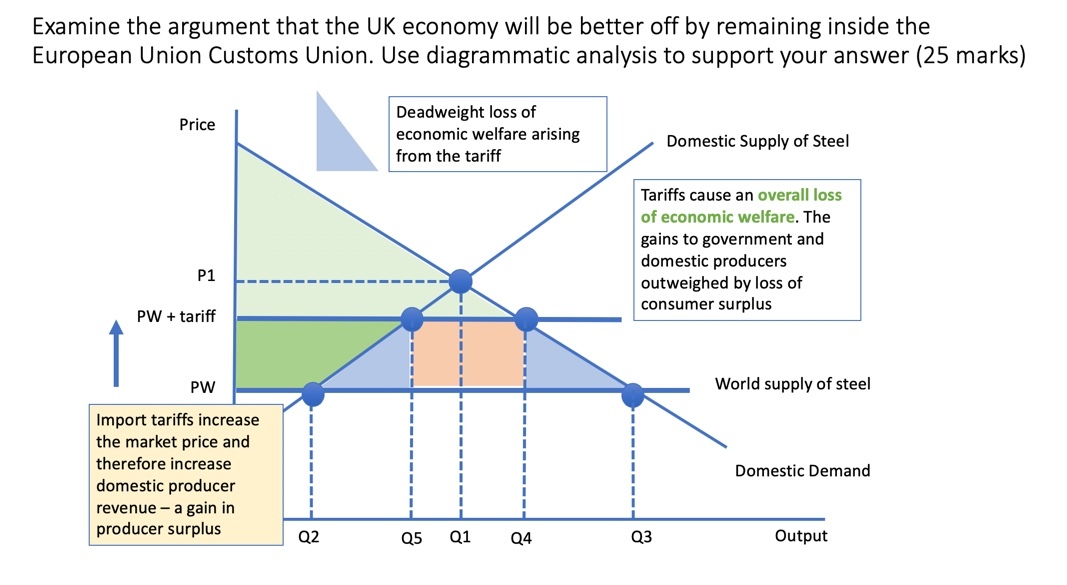
"Examine the argument that the UK economy will be better off by remaining inside the European Union Customs Union. Use diagrammatic analysis to support your answer." (25 Marks)


Contextual background (not part of the answer)
The EU accounted for 46% of UK exports of goods and services and 53% of imports in 2018. The UK had a trade deficit with the EU of £64 billion in 2018 and a trade surplus of £33 billion with non-EU countries. In June 2016, the United Kingdom voted in a referendum to leave the European Union. Some economists argue that the economic performance of the UK economy in the long run would be better served by an agreement to remain inside the EU customs union.

KAA Point 1: Keeping trade frictions low

Customs Union (CU) involves free trade between members & a common external tariff on imports from non-member countries. One argument for remaining is that EU is UK’s biggest trade partner – lots of cross-border trade e.g. component parts. Inside CU makes it less costly for TNCs to invest & produce in the UK and then export to EU. Extra trade friction costs outside CU lead to higher consumer prices & lower real incomes.

EVAL Point 1: Trade with faster-growing economies

Staying outside the Customs Union means that the UK can negotiate new preferential / free trade agreements outside the EU with faster-growing countries such as China, India, Australia, Vietnam and South Korea. Although the EU is the UK’s biggest trade partner, the % of trade in goods and services with the EU has been falling and other parts of the world economy are growing more strongly.

KAA Point 2: Economic costs from EU tariffs

If the UK leaves the Customs Union (and in the absence of a trade deal with the EU) then import tariffs would apply to UK exports. The average EU import tariff is 4.8%. The EU CET ranges from 0% on pharmaceutical products and 11% on footwear to 45% on tobacco. Higher tariffs can damage consumer welfare and lead to regressive effects on the distribution of income along with higher inflation and interest rates.


EVAL Point 2: Average tariffs have been falling

Staying inside the EU customs union would mean that the UK would be obliged to follow changes in EU trade agreements without any say in how they were negotiated. And whilst there would be some additional tariffs initially, a UK-EU trade agreement is likely. Average import tariffs have fallen in recent years which might help mitigate the macroeconomic effects of leaving the EU Customs Union agreement.

FINAL CONCLUSION

Overall, continued membership of the customs union in my opinion is likely to be best for the UK. The gravity theory of trade suggests strongly that we trade more with countries in close proximity and this is unlikely to change fundamentally in the years ahead. The EU has more than sixty five free trade and preferential agreements with over countries including Canada, South Korea and Australia and there is no guarantee that the UK will be able to achieve better deals with these countries on their own. In a globalized world, keeping trade frictions low is vital to continue to attract inward investment. Nissan has a UK workforce of 6,700 and exported around 250,000 cars to the EU in 2015, around half of its output. Those exports would face a tariff of up to 10 per cent outside the customs union unless a free trade deal could be negotiated. Honda has already announced that it will be closing their Swindon plant in 2021. These are important sources of jobs and incomes for regions outside of London, and provide evidence that the UK should continue to stay inside the CU for the foreseeable future.


Current Account Deficit & Policies (Revision Essay Plan)

Here is a revision essay plan on this question: 

"Assess policies that might be most effective in reducing the size of the UK current account deficit in the future." (25 Marks)


In 2018, the UK current account, saw a deficit of £82 billion, compared with £68 billion in 2017. The current account deficit was 3.9% of GDP in 2018 compared with 3.3% in 2017.

KAA Point 1

One demand-side policy is a rise in direct taxation – e.g. increase in income tax – reduces real disposable income – causing contraction in household spending – reduces demand for imports (expenditure-reducing effects) – assuming that the value of exports remains the same - this will lead to an improvement in net trade which is a component of the current account.

EVAL Point 1

Higher direct taxes are not always effective in reducing spending – people may view tax hikes as temporary – and choose to maintain spending by reducing their savings out of disposable income. Reduced consumer spending could also lead to a fall in planned investment which could then hinder the productive capacity of businesses that export.


KAA Point 2

A second approach might be for the Bank of England to try achieve a competitive depreciation of sterling e.g. by keeping interest rates lower, expanding QE or by direct intervention in currency markets. Weaker £ increases M prices and makes exports more competitive (in $s etc) – leading to expenditure-switching effects and an improvement in net trade providing that the Marshall-Lerner condition is met.

EVAL Point 2

The main causes of current account deficit are likely to be structural (e.g. linked to a persistent productivity gap) rather than due to an over-valued exchange rate. The majority of exports also require imports, so weaker £ increases costs of imported raw materials & components and also makes imported technology more expensive which can then hamper price competitiveness in the future.


FINAL CONCLUSION

Demand side policies carry risks (e.g. cuts in real living standards) and the option of a competitive devaluation is not available if the UK continues to operate a free-floating exchange rate system. Supply-side economic reforms can perhaps be more effective in the long run in helping to correct an external deficit. E.g. cuts in corporation tax designed to attract inward investment from overseas e.g. car manufacturing firms which then increases export volumes. Increased spending on STEM education and tax relief for research & development in emerging sectors such as life sciences can raise a country’s export potential in industries where global demand is likely to be strong in the years ahead.


Policies to Improve Competitiveness (Revision Essay Plan)

Here is an answer to this question: 

"With reference to a country of your choice, evaluate policies that might be most effective in improving competitiveness." 

This essay uses Poland as a contextual example, but you could just as easily use the UAE, UK or any country of your choice.

Once you have read the answer, discuss with a friend how you would change the analysis and evaluative points for your chosen country.


Analysis and application point 1

Competitiveness is the ability to sell goods and services successfully at a profit in overseas markets. Poland is a country inside the EU single market but retains their own currency – the Zloty. 25% of Polish exports go to Germany. One policy that might help to improve the price competitiveness of Poland is for the Polish central bank to intervene in the currency market to bring about a competitive depreciation against the Euro. This might be done by lowering policy interest rates or by intervening directly to sell Zloty and buy Euros. A weaker currency would make Polish products relatively cheaper in Western European markets, as a result, there might be expenditure-switching effects as Poland sells more exports and domestic demand for imports contracts since they become more expensive priced in Zloty. A consequence of this might be that Polish exporters will make more profits and this could then help them to increase capital investment. This in turn could cause an increase in productivity which would help maintain competitiveness in the long-term.

Evaluation point 1

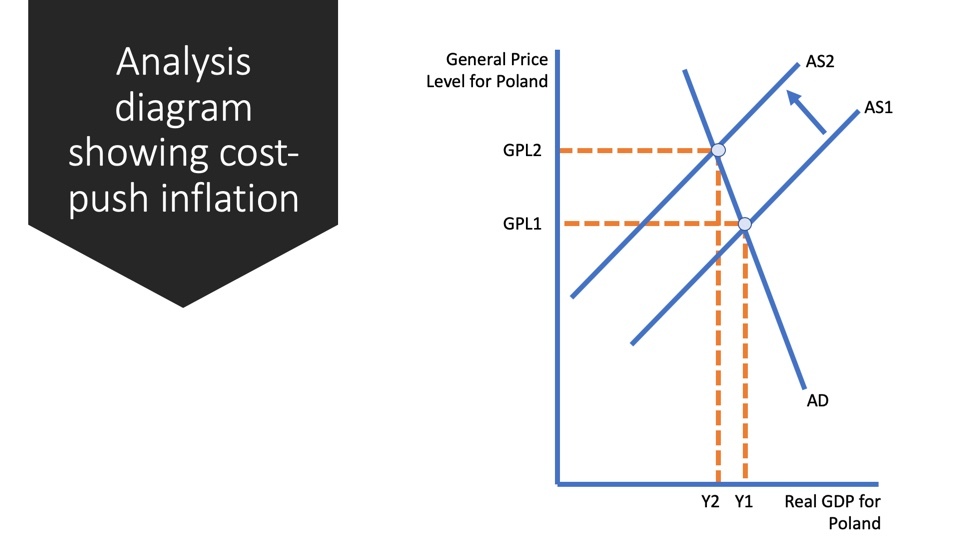
Although in theory a depreciation of the Polish Zloty might improve the price competitiveness of the Polish economy, in practice the benefits might be eroded by some of the negative effects of a weaker currency. For example, Poland imports animal feed, vehicle parts and pharmaceuticals mainly from other EU countries. When the external value of a currency falls, then the domestic price of imported products almost inevitably goes up. This leads to a deterioration in the terms of trade meaning that Poland has to export more to pay for a given volume of imports. Crucially it can and does lead to a rise in cost-push inflation which reduces the real incomes of Polish consumers and also reduces the profits of Polish companies reliant on imports. Higher relative inflation can therefore make Poland less competitive inside the EU single market.


Analysis and application point 2

A second approach to improving competitiveness could be to introduce supply-side economic reforms to the Polish economy. Poland was once a transition economy and has used a number of market-friendly policies during the move away from socialism. These have included reductions in corporation tax and income tax – for example income tax rates in Poland are 18% and 32% contrasted with 20% and 40% in the UK. Lower tax rates have encouraged a rise in the number of business start-ups and inflows of foreign direct investment into the Polish economy. This investment has added to the country’s capital stock and has helped to increase labour productivity which in turn is a key factor causing real per capita incomes to rise. Inward investment also creates the extra productive capacity which increases Poland’s export potential. Foreign-owned firms are said to account for over half of Poland’s exports and the revenue from profits made by transnational businesses manufacturing in Poland also generates extra tax revenues.

Evaluation point 2

Market-friendly supply-side policies can improve the long-term competitiveness but they can also come into conflict with other macro objectives. For example, cuts in direct taxation on household incomes and corporate profits might contribute to more inequality and relative poverty within Poland. Higher inequality can actually damage competitiveness over time in part because a widening gap between the lower middle class and poor households compared to the rest of society might lead to more people being unable to afford good quality education and health care. If education outcomes suffer, then a country will not be improving its human capital as fast as possible and this can lead to structural problems such as higher unemployment and ultimately, lower labour productivity which is a key factor influencing price competitiveness.

Final reasoned comment / conclusion

In the long-term, competitiveness is mainly determined by the supply-side performance of a country. Therefore, I would argue that Poland should use policies that increase investment in education to build up human capital and also encourage more women into the active labour force. Poland actually ranks higher than the UK in the PISA rankings for Maths, Science and Reading. And Poland ranks third for best computer programming talent, ahead of the US and India. Investment in early years, secondary and higher education provides the best platform for improving non-price competitiveness in areas such as innovation, adoption of artificial intelligence and robotic technologies which will matter in years to come.

Sunday, 20 January 2019

Model Answer - Oligopoly 15 mark question

“Explain how interdependence and uncertainty affect the behaviour of firms in oligopolistic markets” (15 marks)

Start with a brief definition of an oligopoly 
An oligopoly is a market dominated by a few producers where there is a high level of market concentration. Examples of markets that can be described as oligopolies include the markets for petrol in the UK, soft drinks producers and the major high street retail banks. Another example is the global market for sports footwear – 60% of which is held by Nike and Adidas.

Develop the explanation
Oligopoly is best defined by the conduct (or behaviour) of firms within a market and this behaviour is often complex - there are many different models of oligopolistic decision-making.
There is no single theory of price and output under conditions of oligopoly. If a price war breaks out, oligopolists may choose produce and price much as a highly competitive industry would; whereas at other times they act like a pure monopoly.

Focus on inter-dependent decision-making and uncertainty
Inter-dependence means that firms must take into account the likely reactions of their rivals to any change in price, output or forms of non-price competition. Game theory can help to understand some of the pay-offs from different decisions made by “players” in a market dominated by a small number of competing businesses.
Because of the uncertainty in the market informal and formal collusive behaviour can common feature of many oligopolistic markets.

For example - tacit collusion such as price leadership where prices and price changes established by a dominant firm, or a firm are usually accepted by others and which other firms in the industry adopt and follow. When price leadership is adopted to facilitate tacit (or silent) collusion, the price leader will generally tend to set a price high enough that the least cost-efficient firm in the market may earn some return above the competitive level.
We see examples of this with the major mortgage lenders and petrol retailers where many suppliers follow the pricing strategies of leading firms. Tacit collusion occurs where firms undertake actions that are likely to minimise a competitive response, e.g. avoiding price cutting or not attacking each other’s market

Some businesses in an oligopoly may choose to enter into price-fixing  or market-sharing cartels. This behaviour is deemed illegal by UK and European competition law. But it is hard to prove that a group of firms have deliberately joined together to raise prices. The EU has recently fined businesses involved in price fixing in the soap powder industry who agreed to raise prices even though they had all made their products smaller for the consumer.

Collusion is often explained by a desire to achieve joint-profit maximisation within a market or prevent price and revenue instability in an industry. Price fixing represents an attempt by suppliers to control supply and fix price at a level close to the level we would expect from a monopoly.  To collude on price, producers must be able to exert some control over market supply.

The explanation for this question can be supported by an analysis diagram for example the kinked-demand curve diagram that supports the idea of sticky prices and a focus on non-price competition within an oligopoly

Sunday, 6 May 2018

Essay Plans 2018 - Government Subsidy

Here is a suggested approach to how A Level Economics students might respond to the essay question "Examine the view that the government should subsidise free entry to museums in the UK."
Museums and Government Subsidy
Examine the view that the government should subsidise free entry to museums in the UK (25)

Point 1: Effective demand

Free entry makes museums more affordable to families and for school visits. This will increase market demand especially from families on lower incomes. Museums could then increase their revenues from cafes and shops and also attract extra revenue from sponsorships for exhibitions. There is a public good aspect to the wider use of museums.
Evaluation:
Museum capacities are limited. They are not pure public goods because space in a museum is rival - i.e. one person’s consumption of an exhibition reduce the amount available for someone else. Free tickets will probably lead to increased congestion, lengthy queues and the need for some kind of rationing for users. For example, the British Museum in London attracted approximately 6.9 million visitors between April 2015 and March 2016 and more than two thirds of the visitors came from overseas.

Point 2: Injection of demand for the local economy

Museums are good for the local economy because they attract visitors / tourists which can act as an injection of demand into the local or regional circular flow and perhaps lead to a multiplier effect which increases employment and real incomes.
Evaluation:
Although tourist revenues are good, if they are enjoying a private marginal benefit from their visit, the benefit-pay principle suggests that they should be making a contribution to the operating cost of the museum. That might allow the museum to charge lower prices to people living in the area. 

Point 3: Externalities and social welfare

There might be positive externalities from the consumption of exhibitions and learning resources available in museums. This means that the social benefit from consumption is higher than the private benefit. Without some form of subsidy that lowers the cost to museum visitors, museums may be under-consumed leading to a potential loss of social welfare. The analysis diagram shows the possible deadweight loss of welfare.
Evaluation:
It is difficult to put a financial value on the positive externalities from museums. And funding museum entry through subsidy involves an opportunity cost. £100 million used for museum subsidy for example might be better spent (from a social welfare point of view) in funding free swimming lessons for the local community or helping to keep open libraries or care centres. Without subsidy, a museum might be more focused on secure charitable donations as a source of revenue.
Analysis diagram to show positive externalities from consumption and the potential for market failure if a product is under-consumed

Final reasoned comment

Ultimately the question of whether to provide a subsidy to museum operators depends on a value judgement. Without subsidy, could museums attract sufficient private sector sponsorship/support to keep ticket prices down? Should taxpayers who live long distances from major towns and cities where most museums are located have to pay for others to benefit? In theory a subsidy for museums can be justified on grounds of positive externalities and helping to overcome a market failure, but in practice some museums might be more in need of subsidy than others. For example, museums in London ought to be able to generate enough revenue from tourist visitors with less need for government subsidy. There might be a case for subsidy to focus on museums in parts of the country less well served by museums and which want to build new facilities to attract visitors and create new jobs.

Tuesday, 24 April 2018

Essay Plans

Please click on the links below to access some model essay plans. Helpful to understand how to plan an essay in the exam.

Essay 1: Here is a suggested essay plan to this question: Evaluate the micro and macro policies a government might use to make food more affordable to lower income groups.

Click here for an essay on food affordability.

Essay 2: Here is a suggested answer to the following question: Examine the role of barriers to entry in earning economic profit.

Click here for essay plan

Essay 3: Here is a suggested approach to how A Level Economics students might respond to the essay question "Examine the view that the government should subsidise free entry to museums in the UK."

Click here for essay plan


Wednesday, 14 February 2018

25 Mark Essay Plan - Housing market

In this video we look at building an answer to a synoptic 25 mark essay question on the micro and macro effects of an increase in house-building in the UK economy. Once again, this could be a synoptic question and therefore would require both micro and macro analysis. 


Micro point 1
An increase in new house-building will lower prices and therefore help to make property more affordable for home-buyers.
For example, eliminating VAT on building new homes on brownfield sites reduces costs for building firms and therefore make it more profitable to construct new homes. An increase in supply can bring down prices for home-buyers if the number of new homes exceeds the increase in demand for property.
Whether prices fall and makes housing more affordable depends on the other costs of building homes. The construction industry might be affected by skills shortages which leads to higher wage costs or higher costs caused by tougher building regulations such as meeting emissions targets.
Micro point 2
Increased house-building may lead to environmental damage which could then be a cause of market failure.
Building new homes can lead to external costs in the form of noise pollution and waste products. Building hundreds of new homes in a local area might negatively affect people already living there and lead to increased congestion on roads.
However a counter argument is that the local authority might insist on construction companies spending money on improving roads and also building new facilities for the local community as part of the planning process.
Macro point 1
Policies that successfully increase the rate of new house-building will help to stimulate UK economic growth in both the short and the long run.
This is because investment in new housing is a component of aggregate demand and is likely to lead to a strong multiplier effect as building is a labour-intensive industry. More homes also increases the geographical mobility of labour which will help to reduce the rate of unemployment in the longer term.
The size of the multiplier effect depends on whether the building industry is able to expand their labour force. They may face skills shortages which leads them to use workers who have migrated from overseas. Their remittances sent home would be a leakage from the circular flow of income.
Macro point 2
An increase in  house-building will lead to a rise in government tax revenues which will help to bring down the fiscal deficit.
House-building companies will make more profits when new homes are sold and pay more corporation tax. More houses will also be bought and sold leading to an increase in revenue from Stamp Duty and VAT on building/DIY materials.
This macro effect depends on the extent to which building homes is actually profitable. Building firms might face higher costs (e.g. imported raw materials) which lowers the rate of return and cuts corporation tax liability.
Final reasoned comment:
There is substantial unmet demand for housing in the UK and a rise in new house-building is likely to provide significant micro and macro benefits. But the government needs to maintain a balance between homes available to buy and those offered for rent since new homes are unaffordable for many people.
Opportunities for analysis diagrams in this question

25 Mark Essay Plan - Financial Market failure

Another 25 mark essay plan, this time on market failure and government policy.


25 Mark Essay Plan - Steel tariffs

Tutor2u are now producing a series of model essay plans for 25 mark essays. I will publish them all on this blog. Just search essay plans and they will pop up....

This one is on Steel tariffs and would be on the synoptic paper 3.


Micro point 1

One micro effect of a tariff on Chinese steel is that steel manufacturing firms in the UK will see an increase in demand and improved profits from selling output.
This is because an import tariff makes Chinese steel more expensive which can lead to expenditure-switching effects. Users of steel such as construction firms may substitute towards relatively cheaper UK steel leading to an outward shift of demand and a higher supernormal profit per tonne of steel supplied.
However the strength of the substitution effect depends on the size of the import tariff because Chinese steel might have been significantly cheaper than the UK. It also depends on whether there is a compensating change in the exchange rate e.g. a devaluation of the Yuan against the £ sterling.

Micro point 2

A second micro effect of a tariff on Chinese steel is that the UK steel industry may become less contestable.
Import tariffs are barriers to trade and they make it harder for imports to compete with domestic suppliers. Weaker import competition increases the monopoly power of UK producers and might lead to both allocative and productive inefficiency.
A counter-argument is that the dumping of cheap steel at a price below cost into the UK by Chinese suppliers is itself an attempt to weaken market competition and give Chinese firms more monopoly power in the long run.


Macro point 1

A macro effect of a tariff on steel is that the policy will help to prevent a rise in structural unemployment in regions where steel-making is a key industry.
The closure of loss-making steel plants creates structural unemployment because workers in these factories often have specific skills that are not fully transferable to other jobs. Workers therefore suffer from occupational immobility.  Rising unemployment can then lead to a negative multiplier effect.
A critique of this point is that a tariff does not address the long-term problems of low productivity and higher unit costs in the UK steel industry. Occupational immobility might be better addressed with a significant increase in government investment in training programs.

Macro point 2

A 2nd macro effect of a tariff is that the current account of the balance of payments is likely to improve.
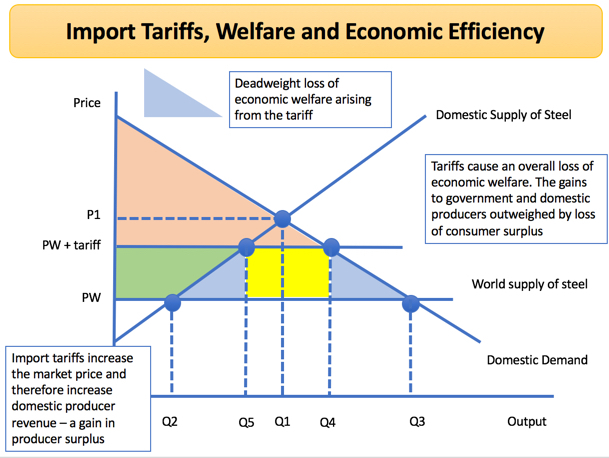
This is because a tariff increases prices and therefore reduces the quantity of imports bought which then leads to a fall in spending on imports. UK steel makers will be able to supply a higher percentage of total market demand for steel.
However, many other industries use steel and will be affected by the tariff. For example, car makers will see rising costs which might make them less price competitive in overseas markets leading to a possible decline in UK exports.

Diagram opportunities for analysis marks

Tariff diagram – showing rise in imported steel price, changes in domestic demand and supply
Welfare diagram – e.g. impact of a tariff on consumer and producer surplus
AD-AS diagram - Rising import costs causing an inward shift of SRAS

Thursday, 1 June 2017

Paper 2: 25 mark essay on monetary & supply side policies

Useful to help you answer an essay on economic policy - paper 2

Wednesday, 31 May 2017

MUST WATCH - FOR PAPER 1 NEXT WEEK

Thank you to Geoff and the team for producing these excellent revision videos on theory of the firm.

Click here to access. I would like to go through them next week.

Sunday, 29 May 2016

Unit 4: Model Answer on Brazilian Economy - June 2013 Paper

Useful to look at what a model answer might look like on a development question.


Tuesday, 23 February 2016

Unit 2 & 4: Fiscal Austerity Essay

Here is a really good example of a student essay that uses strong contextual evidence to build arguments on both sides of the fiscal austerity debate. First Year student Juhwan Sohn answered this question: 

"Evaluate the impact of the UK government’s fiscal austerity programme"
Fiscal austerity in the UK describes decisions made by the government with the aim of reducing the amount of government borrowing, or cutting the size of the fiscal deficit, over a time period adjusting for the effects of the economic cycle. This means that automatic stabilisers (fiscal changes as the economy moves through stages of the economic cycle of recessions and booms) result in the deficit rising and falling as the economy expands and contracts. Fiscal austerity is implemented by cuts in government spending such as welfare caps, “wage freezes” and defence cuts, and an increase in taxes such as the increase in VAT in 2011. 
A fiscal or budget deficit is when the government spending is greater than the tax revenue in a given time period. This means that during a period of economic growth, the cyclical deficit will fall, due to the decrease in spending on unemployment benefits and an increase in government tax revenues. The UK government fiscal austerity programme was introduced by the Conservative and Liberal Democrat coalition in 2010, and almost succeeded in halving the UK budget deficit by the end of 2015. George Osborne’s new fiscal rule (2015) stated a target for a budget surplus by 2019/20 and for all subsequent years in ‘Normal times’ (real annual growth is above 1%). 

Whilst it may make sense to cut the budget deficit and work towards a budget surplus, especially during periods of strong growth, cuts in spending and an increase in taxes are arguably counterproductive and potentially damaging to parts of the UK economy. The impacts of fiscal austerity in the UK has raised questions on whether the government has placed too much emphasis on deficit-cutting in recent years, and it could be argued that running a budget deficit is better than contractionary fiscal policies and there are better alternatives.
Although fiscal austerity has had some success in reducing the budget deficit, it has also resulted in negative impacts on the lower income families in the UK. Cuts in government spending since 2010 such as wage freezes and welfare caps, have had regressive effects in the UK, as it has affected lower income families the most. 
According to a UK case study by Oxfam, as a result of the austerity measures, the poorest two-tenths of the population “have seen greater cuts to their net income in percentage terms than every other group, except the very richest tenth.” Furthermore, according to the Institute for Fiscal Studies, the effect of the tax increases and welfare cuts will be to increase both absolute and relative poverty by 2020. It is estimated that an additional 800,000 children will be living in poverty, and an extra 1.5 million working age adults could slip into poverty. This therefore could lead to a worsening of inequality in the UK, which has risen faster among the working-age population than in any other OECD country. 
The unemployed portion of the UK population has also experienced significant impacts of the austerity programme. Following the cuts in welfare and small increases in taxes, unemployed people have seen a 7% loss of income, worsening their chances of climbing out of unemployment. This could contribute to the growth of long-term unemployment, whilst failing to address the problem of youth unemployment in the UK. Therefore, the regressive impacts of the fiscal austerity programme are damaging to the UK economy in the long term, and can be seen as being counterproductive. The Oxfam case study concludes that “the UK’s current austerity programme threatens to solidify the UK’s position as a country of growing inequality and poverty.”

The UK government’s fiscal austerity programme may not have significantly contributed to and have had a restrictive effect on the UK economic performance on its way to recovery since the 2008-9 crisis. Professor John Van Reenen of the LSE argues that the figures for the UK economic performance over recent years  gives a distorted view of reality, as fast population growth (net immigration is triple the government’s 100,000 target) contributed significantly to the GDP growth rate of 2.7% in 2014, and in comparison with “historic trends, GDP per capita was nearly 16% lower in 2014- a loss of about £4,500”. Further to this UK productivity measured by GDP per hour is approximately 16% below the trend and 17% below the G7 average. 
John Van Reenen has labeled the UK’s performance as “the worst recovery this century” and argues that plans for continued austerity would decrease the budget deficit but would also sacrifice investment, growth and employment, thus further affecting the already weak economic performance. The government’s contractionary fiscal policy and accelerated austerity such as increased in VAT to 20% in 2011, £32 billion of spending cuts by 2015 and an enormous 40% real cut in public investment during 2010-12, could have restricted the prospects of economic growth, especially following a recession and contributed to the UK’s poor economic performance due to factors such as the lack of multipliers (a change in one of the opponents of aggregate demand can lead to a multiplied final change in the equilibrium level of GDP) from investment. 
The OBR estimated that approximately 2% of GDP was lost due to austerity policies by the government. The fiscal austerity programme is arguably acting as a dragging force on the UK economy’s road to recovery. Having said all this, many other factors outside of the state’s control have also contributed towards “the worst recovery this century”. The eurozone crisis has had a drag on the UK economy and the decline of productivity in sectors such as oil and finances has played a role in the UK’s economic performance. However, the fiscal austerity measures undoubtedly forms a part of the reasons behind the poor performance.
Fiscal conservatives argue that a deficit reduction and balancing of budgets through a fiscal austerity programme will help maintain the UK’s international credit rating as well as improving confidence among domestic and foreign investors, encouraging an inflow of capital which could result in an increase in aggregate demand and aggregate supply (economic growth). The maintenance of a good credit rating should lower interest rates on bonds and this is shown by the fact that the yield on the UK government bond is 2%. The yield on a bond is calculated by coupon(annual interest)/market price x 100%. However, following the UK credit rating downgrade in 2013, the government was called to “ease the pace” of austerity. The UK still has a triple A rating from Standard & Poor, and a AA+ rating from Fitch, but in 2013 the UK lost Moody’s rating of AAA and was downgraded to AA1 due to the “continuing weakness in the UK’s medium-term growth outlook” according to Moody. Tristan Cooper, sovereign debt analyst at Fidelity Worldwide Investment stated that “now that the UK’s triple-A rating has been lost, it probably makes sense for the Chancellor to ease the pace of fiscal consolidation”. This shows that although fiscal austerity has not significantly harmed the UK’s credit rating or confidence among investors, its contractionary and restrictive nature could be a cause for concern. 


The concerns for the UK government’s fiscal austerity programme seems to be justifiable in numerous cases, as cutting the budget deficit does seem to be coming at a significant cost to other aspects of the UK economy. An alternative, and perhaps less harmful approach to cutting government spending to reduce the budget deficit may be to cut middle-class benefits to fund infrastructure spending in the UK. According to the Social Market Foundation (SMF), welfare and benefits for the relatively better-off families should be reduced and reinvested infrastructure projects. It estimates that £15 billion could be raised by cutting free bus passes and television licences for better-off pensioners, halving higher-rate pension tax relief (reduction in the amount of pension tax owed by an individual) and removing child benefits for the top 50% of income earners. This could lead to a significant cut in public spending and it would go towards a more expansionary policy. However, according to The Guardian, this alternative is unlikely to be taken up by a Conservative government, “as they will not want to cut pension tax relief for a core segment of their voters.” Another alternative to fiscal austerity, offered by Keynesians, is counter-cyclical fiscal policy. This means going against the economic cycle and during a recession, the government should send and borrow more to stimulate economic growth. This suggests that running a budget deficit is not very damaging to the economy and is better than paying the costs of correcting it through a fiscal austerity programme. Furthermore, Keynesians argue that running a budget deficit and borrowing more to stimulate growth could be partly self-financing. For example, when increased borrowing leads to an increase in incomes and tax revenues for the government. 
This approach is to allow economic growth through fiscal stimulus to bring the deficit down gradually through higher tax revenues and lower spending on benefits as the economy grows. Increased in spending especially on infrastructure projects, made possible by a rise in borrowing, could result in fiscal multipliers in the long run, as well as increases in the productive capacity of the economy. However, the Economist argues that “since [infrastructure] projects take time and money to construct, the argument for infrastructure spending having a positive impact on productivity in the short-term is difficult to quantify.” Therefore it could be said that running a budget deficit and borrowing more is likely to benefit the economy in the long run.
Overall, although the UK government’s fiscal austerity programme following the economic crisis of 2008-9 has significantly reduced the budget deficit, it has come at a significant cost and damage to other aspects of the economy, which could have long term implications. The austerity programme cannot be written off and branded as being completely damaging and useless, but an easing of or simply less austerity may be more effective in reducing the deficit without having serious implications for the economic performance. 

This reflects the views of economists such as Jonathan Portes, the director of the National Institute of Economic and Social Research and Ed Balls who blamed the economic performance since 2010 on the severe fiscal austerity programme. Jonathan Portes stated that “Fiscal consolidation has slowed, at least for the time being, and as a consequence it is playing a considerably smaller role in driving economic developments than it did two years ago”. A looser austerity measure may enable the government to rebalance the UK economy without doing further damage to the UK economy, and alternative measures that could work in tandem with a less severe austerity programme should also be considered.