Total Pageviews

Showing posts with label essay plans. Show all posts

Sunday, 19 May 2019

Fiscal Policy and inequality - Essay plan

Here is an essay plan for a question on inequality. "Discuss the extent to which fiscal policy alone can reduce income inequality."
IMF (2015) "Fiscal policy is the primary tool for governments to affect income distribution"
Income inequality
Skewed distribution, large gap between rich and relatively poorer households
Measured by 
  • Gini coefficient: Coefficient ranges from zero to one (perfect inequality)
Show contextual awareness 
  • Low income inequality in countries such as Sweden, Finland, Slovenia (all have Gini of less than 0.3)
  • UK income inequality has been declining in recent years (Gini for final income of 0.34)
  • Much higher in countries such as South Africa, China, USA
Remember! Analyse first and then evaluate!
Analyse how fiscal policy can reduce income inequality
(1) Increase in level of means-tested welfare benefits such as income support / housing benefit - targets help on those families in relative poverty in greatest need
Evaluation: Increased complexity and cost of running welfare, risk of poverty trap from withdrawal of income-related benefits, risk of more families gaming the system; doesn’t address root causes of inequality such as low pay / skills gaps
(2) Increase the marginal rate of income tax for top earners e.g. from 45% to 50% - designed to make the tax system more progressive.
Evaluation: Higher top rate taxes might lead to increased tax avoidance, tax evasion, a possible brain drain of highly skilled people. Risk of lower total tax revenues (tax rates beyond the optimal point in a Laffer Curve diagram). Lower revenue affects ability of government to provide public and merit goods
(3) Introduce a progressive consumption tax e.g. higher rates of VAT on luxury products / lower VAT on essential items (e.g. energy)
Evaluation: Who decides what is a luxury product? VAT is already zero on much household spending.
(4) Increase in the income tax free allowance e.g. from £11,600 to £13,000 - this is designed to improve work incentives because people start paying income tax at higher incomes. Government could also increase the level at which people start to pay national insurance contributions.
Evaluation: Helps people in lower-paid jobs but many of the relatively poor are not in work e.g. structurally unemployed, retired, suffering from chronic illnesses. Lifting the income tax free allowance is also expensive - would it be made available to all?
Further evaluation of the question
Focus on the stem word 'alone'
Introduce some alternatives into the discussion:
  1. A higher national minimum wage / + widespread adoption of a more generous living wage
  2. Supply-side policies to improve occupational mobility of labour / address skills gaps which keep people out of work
  3. Address the chronic shortage of and high price of housing which impedes geographical mobility of labour 
  4. Policies to introduce competition into markets to increase contestability and lower real prices e.g. helping to lower energy bills
  5. A more ambitious regional  and industrial policy to address long-term inequalities in employment and income in depressed regions/localities
Finish off the essay with a final reasoned comment 
e.g. There are some powerful forces (such as globalisation) driving income and wealth inequality in many societies, to what extent can fiscal policy alone reverse these factors? Strategies to increase employment in higher-skilled, emerging industries might be the most effective long term strategy?
High levels of government debt and common use of fiscal austerity may have made redistribution a lower priority for many governments.
In-kind benefits, such as education spending and better quality of and access to health care can also affect the inequality of market incomes in the long run.

Sunday, 6 May 2018

Essay Plans 2018 - Government Subsidy

Here is a suggested approach to how A Level Economics students might respond to the essay question "Examine the view that the government should subsidise free entry to museums in the UK."
Museums and Government Subsidy
Examine the view that the government should subsidise free entry to museums in the UK (25)

Point 1: Effective demand

Free entry makes museums more affordable to families and for school visits. This will increase market demand especially from families on lower incomes. Museums could then increase their revenues from cafes and shops and also attract extra revenue from sponsorships for exhibitions. There is a public good aspect to the wider use of museums.
Evaluation:
Museum capacities are limited. They are not pure public goods because space in a museum is rival - i.e. one person’s consumption of an exhibition reduce the amount available for someone else. Free tickets will probably lead to increased congestion, lengthy queues and the need for some kind of rationing for users. For example, the British Museum in London attracted approximately 6.9 million visitors between April 2015 and March 2016 and more than two thirds of the visitors came from overseas.

Point 2: Injection of demand for the local economy

Museums are good for the local economy because they attract visitors / tourists which can act as an injection of demand into the local or regional circular flow and perhaps lead to a multiplier effect which increases employment and real incomes.
Evaluation:
Although tourist revenues are good, if they are enjoying a private marginal benefit from their visit, the benefit-pay principle suggests that they should be making a contribution to the operating cost of the museum. That might allow the museum to charge lower prices to people living in the area. 

Point 3: Externalities and social welfare

There might be positive externalities from the consumption of exhibitions and learning resources available in museums. This means that the social benefit from consumption is higher than the private benefit. Without some form of subsidy that lowers the cost to museum visitors, museums may be under-consumed leading to a potential loss of social welfare. The analysis diagram shows the possible deadweight loss of welfare.
Evaluation:
It is difficult to put a financial value on the positive externalities from museums. And funding museum entry through subsidy involves an opportunity cost. £100 million used for museum subsidy for example might be better spent (from a social welfare point of view) in funding free swimming lessons for the local community or helping to keep open libraries or care centres. Without subsidy, a museum might be more focused on secure charitable donations as a source of revenue.
Analysis diagram to show positive externalities from consumption and the potential for market failure if a product is under-consumed

Final reasoned comment

Ultimately the question of whether to provide a subsidy to museum operators depends on a value judgement. Without subsidy, could museums attract sufficient private sector sponsorship/support to keep ticket prices down? Should taxpayers who live long distances from major towns and cities where most museums are located have to pay for others to benefit? In theory a subsidy for museums can be justified on grounds of positive externalities and helping to overcome a market failure, but in practice some museums might be more in need of subsidy than others. For example, museums in London ought to be able to generate enough revenue from tourist visitors with less need for government subsidy. There might be a case for subsidy to focus on museums in parts of the country less well served by museums and which want to build new facilities to attract visitors and create new jobs.

Tuesday, 24 April 2018

Essay Plans

Please click on the links below to access some model essay plans. Helpful to understand how to plan an essay in the exam.

Essay 1: Here is a suggested essay plan to this question: Evaluate the micro and macro policies a government might use to make food more affordable to lower income groups.

Click here for an essay on food affordability.

Essay 2: Here is a suggested answer to the following question: Examine the role of barriers to entry in earning economic profit.

Click here for essay plan

Essay 3: Here is a suggested approach to how A Level Economics students might respond to the essay question "Examine the view that the government should subsidise free entry to museums in the UK."

Click here for essay plan


Monday, 9 April 2018

A2 Essay Plan - Reducing a trade deficit

Excellent piece on how to structure an essay on reducing a trade deficit.


Wednesday, 14 February 2018

25 Mark Essay Plan - Housing market

In this video we look at building an answer to a synoptic 25 mark essay question on the micro and macro effects of an increase in house-building in the UK economy. Once again, this could be a synoptic question and therefore would require both micro and macro analysis. 


Micro point 1
An increase in new house-building will lower prices and therefore help to make property more affordable for home-buyers.
For example, eliminating VAT on building new homes on brownfield sites reduces costs for building firms and therefore make it more profitable to construct new homes. An increase in supply can bring down prices for home-buyers if the number of new homes exceeds the increase in demand for property.
Whether prices fall and makes housing more affordable depends on the other costs of building homes. The construction industry might be affected by skills shortages which leads to higher wage costs or higher costs caused by tougher building regulations such as meeting emissions targets.
Micro point 2
Increased house-building may lead to environmental damage which could then be a cause of market failure.
Building new homes can lead to external costs in the form of noise pollution and waste products. Building hundreds of new homes in a local area might negatively affect people already living there and lead to increased congestion on roads.
However a counter argument is that the local authority might insist on construction companies spending money on improving roads and also building new facilities for the local community as part of the planning process.
Macro point 1
Policies that successfully increase the rate of new house-building will help to stimulate UK economic growth in both the short and the long run.
This is because investment in new housing is a component of aggregate demand and is likely to lead to a strong multiplier effect as building is a labour-intensive industry. More homes also increases the geographical mobility of labour which will help to reduce the rate of unemployment in the longer term.
The size of the multiplier effect depends on whether the building industry is able to expand their labour force. They may face skills shortages which leads them to use workers who have migrated from overseas. Their remittances sent home would be a leakage from the circular flow of income.
Macro point 2
An increase in  house-building will lead to a rise in government tax revenues which will help to bring down the fiscal deficit.
House-building companies will make more profits when new homes are sold and pay more corporation tax. More houses will also be bought and sold leading to an increase in revenue from Stamp Duty and VAT on building/DIY materials.
This macro effect depends on the extent to which building homes is actually profitable. Building firms might face higher costs (e.g. imported raw materials) which lowers the rate of return and cuts corporation tax liability.
Final reasoned comment:
There is substantial unmet demand for housing in the UK and a rise in new house-building is likely to provide significant micro and macro benefits. But the government needs to maintain a balance between homes available to buy and those offered for rent since new homes are unaffordable for many people.
Opportunities for analysis diagrams in this question

25 Mark Essay Plan - Financial Market failure

Another 25 mark essay plan, this time on market failure and government policy.


25 Mark Essay Plan - Steel tariffs

Tutor2u are now producing a series of model essay plans for 25 mark essays. I will publish them all on this blog. Just search essay plans and they will pop up....

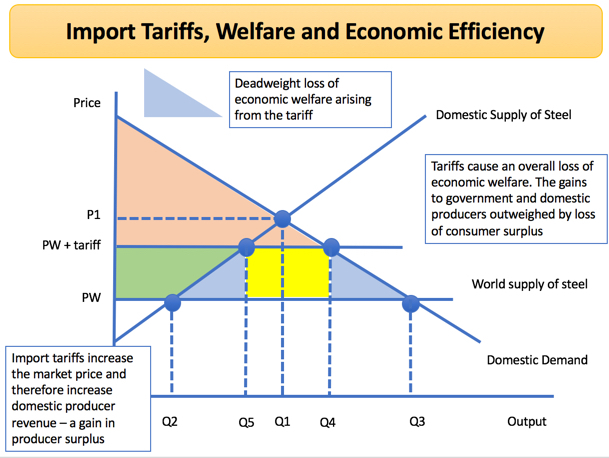
This one is on Steel tariffs and would be on the synoptic paper 3.


Micro point 1

One micro effect of a tariff on Chinese steel is that steel manufacturing firms in the UK will see an increase in demand and improved profits from selling output.
This is because an import tariff makes Chinese steel more expensive which can lead to expenditure-switching effects. Users of steel such as construction firms may substitute towards relatively cheaper UK steel leading to an outward shift of demand and a higher supernormal profit per tonne of steel supplied.
However the strength of the substitution effect depends on the size of the import tariff because Chinese steel might have been significantly cheaper than the UK. It also depends on whether there is a compensating change in the exchange rate e.g. a devaluation of the Yuan against the £ sterling.

Micro point 2

A second micro effect of a tariff on Chinese steel is that the UK steel industry may become less contestable.
Import tariffs are barriers to trade and they make it harder for imports to compete with domestic suppliers. Weaker import competition increases the monopoly power of UK producers and might lead to both allocative and productive inefficiency.
A counter-argument is that the dumping of cheap steel at a price below cost into the UK by Chinese suppliers is itself an attempt to weaken market competition and give Chinese firms more monopoly power in the long run.


Macro point 1

A macro effect of a tariff on steel is that the policy will help to prevent a rise in structural unemployment in regions where steel-making is a key industry.
The closure of loss-making steel plants creates structural unemployment because workers in these factories often have specific skills that are not fully transferable to other jobs. Workers therefore suffer from occupational immobility.  Rising unemployment can then lead to a negative multiplier effect.
A critique of this point is that a tariff does not address the long-term problems of low productivity and higher unit costs in the UK steel industry. Occupational immobility might be better addressed with a significant increase in government investment in training programs.

Macro point 2

A 2nd macro effect of a tariff is that the current account of the balance of payments is likely to improve.
This is because a tariff increases prices and therefore reduces the quantity of imports bought which then leads to a fall in spending on imports. UK steel makers will be able to supply a higher percentage of total market demand for steel.
However, many other industries use steel and will be affected by the tariff. For example, car makers will see rising costs which might make them less price competitive in overseas markets leading to a possible decline in UK exports.

Diagram opportunities for analysis marks

Tariff diagram – showing rise in imported steel price, changes in domestic demand and supply
Welfare diagram – e.g. impact of a tariff on consumer and producer surplus
AD-AS diagram - Rising import costs causing an inward shift of SRAS