Total Pageviews

Showing posts with label essay question. Show all posts

Tuesday, 7 May 2019

Essay Model Answer - Protectionism and current account

Evaluate the significance for the UK balance of payments on the current account of increased use of protectionist policies around the world. (25 Marks)

Protectionist policies are used to prevent the number of imports, and encourage people to purchase domestic goods/services, these include tariffs and quotas. These policies are used to help reduce the deficit a country may have-the UK has a trading deficit, mostly due to the fact it imports more than it exports. They protect domestic industries in several ways; a tariff is a tax places on imported goods and a quota limits the number of imports brought into the country. Protectionist policies also include non-tariff barriers such as rules and regulations with regard to health and safety. The balance of payments on current account is made up of four components; 1) trade in goods 2) trade in services 3) investment income 4) balance transfers. 

Currently the UK has a deficit in the trade of goods (imports-exports). This could be made further if there was an increase in protectionist policies around the world. Exports from the UK is already minimal, if protection policies such as tariffs were put in place it could reduce the number of them even further. This is because the price of UK exports would increase. This means people abroad would no longer buy UK goods and would put domestic businesses that rely on exports at risk.  

However, it is likely the UK would retaliate by placing tariffs on imports coming into the UK. Therefore if the UK was to became more efficient in producing goods, sales would increase heavily domestically. The tariff will also depend on the type of good, if it is inelastic it is unlikely to have any effect e.g. oil. Therefore tariffs may have little effect on the UK's balance of trade.

By placing quotas on exports, the UK would have limit the amount of goods/services exported. Due to the restricted number, it is likely the price for the exported good would increase, which could possibly lead to decreased demand. The UK have a surplus in their trade in services. By limiting the amount, this surplus could deteriorate as less banks for example could set up abroad. This would heavily effect the UK's balance of payments. 

However, as previously said the number of UK exports is already low, therefore quotas may not have a significant impact on the trade of goods. This is because the UK has a deficit as is, and this is NOT due to protectionist policies. This suggests that if protectionist policies were put in place, the UK balance of payments would be mildly effected as they are a predominantly importing country. 

Non-tariff barriers such as administration costs will also effect the UK balance of payments. This will make it difficult for the UK to export goods due to regulations such as health and safety. This could increase there trade deficit as they will be restricted on the amount of exports. The UK will most likely enforce similar laws to imports, this will make trade all together more difficult. If the UK is limited to the number of exports, domestic industries will suffer as they can no longer sell their goods abroad and the only market they access to are the domestic markets. Therefore the trade deficit will worsen.

However non-tariff barriers wont be significant in limiting the number of exports. It is unlikely administration will reduce the amount of exports to have a significant impact on the balance of trade. The Uk is also part of the EU which is their main trading bloc, this means that if other countries use protection policies the UK wont be heavily effected as they will maintain their relationship with the EU. 


Overall, if protectionist policies around the world were to increase it could worsen the UK deficit. This is due to a fall in the level of exports and the inability to set up businesses abroad. However it would depend on how strong the protectionism policies were and if the EU were involved. The fact that the UK doesn't export large amounts suggests that it might a very limited effect on the UK balance of payments of current account. 

Essay model answer - Determinants of demand for imports

This is a 20 mark answer. It could be asked as a 25 marker. You would add one more point to this essay to gain the extra marks.

Assess the main economic determinants of a country's demand for imports (20)


An import is a good or service that has been brought in from abroad. The money from the specific import will go back to the country it came from. Imports are apart of balance of payments, and if imports too high it can ultimately cause a trade deficit.

Income elasticity of demand plays a key role in determining the amount of imports a country will demand. People in the UK are experiencing a period of increasing disposable income, this means they will demand more imports-the richer people feel, the more imports they will buy. Imports are seen to be a of better quality or luxury goods when compared to domestic products, for example wine from France. This is because of the increased choice of products. UK consumers will purchase imports as they are exposed to readily available, higher quality products. Therefore a rise in income will likely result in increased imports.

However, income elasticity of demand may not be as significant. People may choose to save their money rather that purchase expensive imports. Due to the current state of the of the UK people wont have the confidence to 'splash' money around. It is more likely that people will save money, this could therefore decrease the demand of imports.

Comparative advantage is when a lone country as a lower opportunity costs. This means it is more efficient for a country to focus on producing what they have comparative advantage in, and import the good/services that they don't. For example the UK have comparative advantage in pharmaceuticals. This means that countries around the world would demand pharmaceuticals from the UK as they are nest at producing them. Therefore the demand for imports from the UK would increase, as countries were better off importing them rather than producing their own pharmaceuticals.

However, comparative advantage may not work in the long run unless they reinvest. For example, the UK used to have comparative advantage in ships, however they did not reinvest and lost this advantage. The demand for the product may decrease all together. The increasing discoveries of new technology means that the demand of products will fall in specific areas, and therefore imports will decrease.

Finally, countries may lack vital resources such as oil which will lead to an enormous increase in demand for imports. In the UK it impossible for them to produce enough oil to go round. Therefore, as it is an inelastic good, they have no choice but to import.

Overall, countries demand imports for several reasons. Imports on a global scale are increasing due to various factors such as a decrease in protectionist polices. The most significant detriment of a countries demand for imports is due to income elasticity demand, as it has allowed the number of imports demanded to increase rapidly.

Monday, 6 May 2019

EU Customs Union Membership (Revision Essay Plan)

Here is a suggested essay plan to this question: 


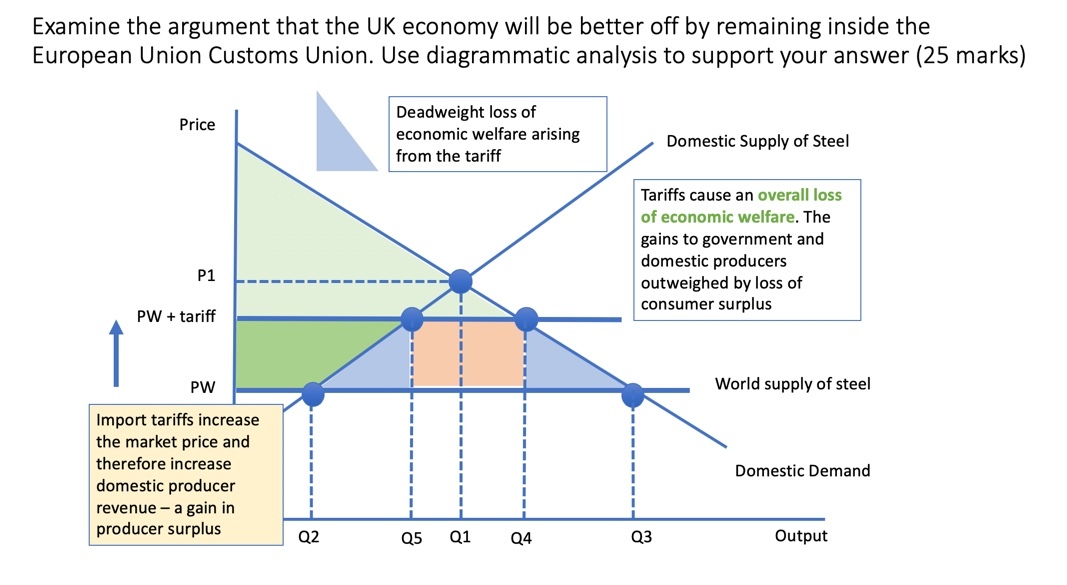
"Examine the argument that the UK economy will be better off by remaining inside the European Union Customs Union. Use diagrammatic analysis to support your answer." (25 Marks)


Contextual background (not part of the answer)
The EU accounted for 46% of UK exports of goods and services and 53% of imports in 2018. The UK had a trade deficit with the EU of £64 billion in 2018 and a trade surplus of £33 billion with non-EU countries. In June 2016, the United Kingdom voted in a referendum to leave the European Union. Some economists argue that the economic performance of the UK economy in the long run would be better served by an agreement to remain inside the EU customs union.

KAA Point 1: Keeping trade frictions low

Customs Union (CU) involves free trade between members & a common external tariff on imports from non-member countries. One argument for remaining is that EU is UK’s biggest trade partner – lots of cross-border trade e.g. component parts. Inside CU makes it less costly for TNCs to invest & produce in the UK and then export to EU. Extra trade friction costs outside CU lead to higher consumer prices & lower real incomes.

EVAL Point 1: Trade with faster-growing economies

Staying outside the Customs Union means that the UK can negotiate new preferential / free trade agreements outside the EU with faster-growing countries such as China, India, Australia, Vietnam and South Korea. Although the EU is the UK’s biggest trade partner, the % of trade in goods and services with the EU has been falling and other parts of the world economy are growing more strongly.

KAA Point 2: Economic costs from EU tariffs

If the UK leaves the Customs Union (and in the absence of a trade deal with the EU) then import tariffs would apply to UK exports. The average EU import tariff is 4.8%. The EU CET ranges from 0% on pharmaceutical products and 11% on footwear to 45% on tobacco. Higher tariffs can damage consumer welfare and lead to regressive effects on the distribution of income along with higher inflation and interest rates.


EVAL Point 2: Average tariffs have been falling

Staying inside the EU customs union would mean that the UK would be obliged to follow changes in EU trade agreements without any say in how they were negotiated. And whilst there would be some additional tariffs initially, a UK-EU trade agreement is likely. Average import tariffs have fallen in recent years which might help mitigate the macroeconomic effects of leaving the EU Customs Union agreement.

FINAL CONCLUSION

Overall, continued membership of the customs union in my opinion is likely to be best for the UK. The gravity theory of trade suggests strongly that we trade more with countries in close proximity and this is unlikely to change fundamentally in the years ahead. The EU has more than sixty five free trade and preferential agreements with over countries including Canada, South Korea and Australia and there is no guarantee that the UK will be able to achieve better deals with these countries on their own. In a globalized world, keeping trade frictions low is vital to continue to attract inward investment. Nissan has a UK workforce of 6,700 and exported around 250,000 cars to the EU in 2015, around half of its output. Those exports would face a tariff of up to 10 per cent outside the customs union unless a free trade deal could be negotiated. Honda has already announced that it will be closing their Swindon plant in 2021. These are important sources of jobs and incomes for regions outside of London, and provide evidence that the UK should continue to stay inside the CU for the foreseeable future.


Current Account Deficit & Policies (Revision Essay Plan)

Here is a revision essay plan on this question: 

"Assess policies that might be most effective in reducing the size of the UK current account deficit in the future." (25 Marks)


In 2018, the UK current account, saw a deficit of £82 billion, compared with £68 billion in 2017. The current account deficit was 3.9% of GDP in 2018 compared with 3.3% in 2017.

KAA Point 1

One demand-side policy is a rise in direct taxation – e.g. increase in income tax – reduces real disposable income – causing contraction in household spending – reduces demand for imports (expenditure-reducing effects) – assuming that the value of exports remains the same - this will lead to an improvement in net trade which is a component of the current account.

EVAL Point 1

Higher direct taxes are not always effective in reducing spending – people may view tax hikes as temporary – and choose to maintain spending by reducing their savings out of disposable income. Reduced consumer spending could also lead to a fall in planned investment which could then hinder the productive capacity of businesses that export.


KAA Point 2

A second approach might be for the Bank of England to try achieve a competitive depreciation of sterling e.g. by keeping interest rates lower, expanding QE or by direct intervention in currency markets. Weaker £ increases M prices and makes exports more competitive (in $s etc) – leading to expenditure-switching effects and an improvement in net trade providing that the Marshall-Lerner condition is met.

EVAL Point 2

The main causes of current account deficit are likely to be structural (e.g. linked to a persistent productivity gap) rather than due to an over-valued exchange rate. The majority of exports also require imports, so weaker £ increases costs of imported raw materials & components and also makes imported technology more expensive which can then hamper price competitiveness in the future.


FINAL CONCLUSION

Demand side policies carry risks (e.g. cuts in real living standards) and the option of a competitive devaluation is not available if the UK continues to operate a free-floating exchange rate system. Supply-side economic reforms can perhaps be more effective in the long run in helping to correct an external deficit. E.g. cuts in corporation tax designed to attract inward investment from overseas e.g. car manufacturing firms which then increases export volumes. Increased spending on STEM education and tax relief for research & development in emerging sectors such as life sciences can raise a country’s export potential in industries where global demand is likely to be strong in the years ahead.


Policies to Improve Competitiveness (Revision Essay Plan)

Here is an answer to this question: 

"With reference to a country of your choice, evaluate policies that might be most effective in improving competitiveness." 

This essay uses Poland as a contextual example, but you could just as easily use the UAE, UK or any country of your choice.

Once you have read the answer, discuss with a friend how you would change the analysis and evaluative points for your chosen country.


Analysis and application point 1

Competitiveness is the ability to sell goods and services successfully at a profit in overseas markets. Poland is a country inside the EU single market but retains their own currency – the Zloty. 25% of Polish exports go to Germany. One policy that might help to improve the price competitiveness of Poland is for the Polish central bank to intervene in the currency market to bring about a competitive depreciation against the Euro. This might be done by lowering policy interest rates or by intervening directly to sell Zloty and buy Euros. A weaker currency would make Polish products relatively cheaper in Western European markets, as a result, there might be expenditure-switching effects as Poland sells more exports and domestic demand for imports contracts since they become more expensive priced in Zloty. A consequence of this might be that Polish exporters will make more profits and this could then help them to increase capital investment. This in turn could cause an increase in productivity which would help maintain competitiveness in the long-term.

Evaluation point 1

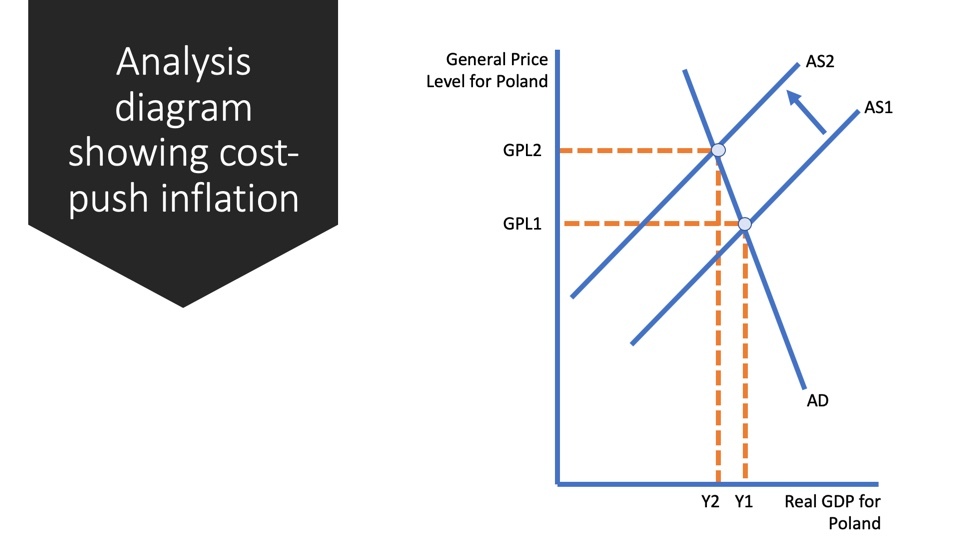
Although in theory a depreciation of the Polish Zloty might improve the price competitiveness of the Polish economy, in practice the benefits might be eroded by some of the negative effects of a weaker currency. For example, Poland imports animal feed, vehicle parts and pharmaceuticals mainly from other EU countries. When the external value of a currency falls, then the domestic price of imported products almost inevitably goes up. This leads to a deterioration in the terms of trade meaning that Poland has to export more to pay for a given volume of imports. Crucially it can and does lead to a rise in cost-push inflation which reduces the real incomes of Polish consumers and also reduces the profits of Polish companies reliant on imports. Higher relative inflation can therefore make Poland less competitive inside the EU single market.


Analysis and application point 2

A second approach to improving competitiveness could be to introduce supply-side economic reforms to the Polish economy. Poland was once a transition economy and has used a number of market-friendly policies during the move away from socialism. These have included reductions in corporation tax and income tax – for example income tax rates in Poland are 18% and 32% contrasted with 20% and 40% in the UK. Lower tax rates have encouraged a rise in the number of business start-ups and inflows of foreign direct investment into the Polish economy. This investment has added to the country’s capital stock and has helped to increase labour productivity which in turn is a key factor causing real per capita incomes to rise. Inward investment also creates the extra productive capacity which increases Poland’s export potential. Foreign-owned firms are said to account for over half of Poland’s exports and the revenue from profits made by transnational businesses manufacturing in Poland also generates extra tax revenues.

Evaluation point 2

Market-friendly supply-side policies can improve the long-term competitiveness but they can also come into conflict with other macro objectives. For example, cuts in direct taxation on household incomes and corporate profits might contribute to more inequality and relative poverty within Poland. Higher inequality can actually damage competitiveness over time in part because a widening gap between the lower middle class and poor households compared to the rest of society might lead to more people being unable to afford good quality education and health care. If education outcomes suffer, then a country will not be improving its human capital as fast as possible and this can lead to structural problems such as higher unemployment and ultimately, lower labour productivity which is a key factor influencing price competitiveness.

Final reasoned comment / conclusion

In the long-term, competitiveness is mainly determined by the supply-side performance of a country. Therefore, I would argue that Poland should use policies that increase investment in education to build up human capital and also encourage more women into the active labour force. Poland actually ranks higher than the UK in the PISA rankings for Maths, Science and Reading. And Poland ranks third for best computer programming talent, ahead of the US and India. Investment in early years, secondary and higher education provides the best platform for improving non-price competitiveness in areas such as innovation, adoption of artificial intelligence and robotic technologies which will matter in years to come.

Sunday, 6 May 2018

Essay Plans 2018 - Government Subsidy

Here is a suggested approach to how A Level Economics students might respond to the essay question "Examine the view that the government should subsidise free entry to museums in the UK."
Museums and Government Subsidy
Examine the view that the government should subsidise free entry to museums in the UK (25)

Point 1: Effective demand

Free entry makes museums more affordable to families and for school visits. This will increase market demand especially from families on lower incomes. Museums could then increase their revenues from cafes and shops and also attract extra revenue from sponsorships for exhibitions. There is a public good aspect to the wider use of museums.
Evaluation:
Museum capacities are limited. They are not pure public goods because space in a museum is rival - i.e. one person’s consumption of an exhibition reduce the amount available for someone else. Free tickets will probably lead to increased congestion, lengthy queues and the need for some kind of rationing for users. For example, the British Museum in London attracted approximately 6.9 million visitors between April 2015 and March 2016 and more than two thirds of the visitors came from overseas.

Point 2: Injection of demand for the local economy

Museums are good for the local economy because they attract visitors / tourists which can act as an injection of demand into the local or regional circular flow and perhaps lead to a multiplier effect which increases employment and real incomes.
Evaluation:
Although tourist revenues are good, if they are enjoying a private marginal benefit from their visit, the benefit-pay principle suggests that they should be making a contribution to the operating cost of the museum. That might allow the museum to charge lower prices to people living in the area. 

Point 3: Externalities and social welfare

There might be positive externalities from the consumption of exhibitions and learning resources available in museums. This means that the social benefit from consumption is higher than the private benefit. Without some form of subsidy that lowers the cost to museum visitors, museums may be under-consumed leading to a potential loss of social welfare. The analysis diagram shows the possible deadweight loss of welfare.
Evaluation:
It is difficult to put a financial value on the positive externalities from museums. And funding museum entry through subsidy involves an opportunity cost. £100 million used for museum subsidy for example might be better spent (from a social welfare point of view) in funding free swimming lessons for the local community or helping to keep open libraries or care centres. Without subsidy, a museum might be more focused on secure charitable donations as a source of revenue.
Analysis diagram to show positive externalities from consumption and the potential for market failure if a product is under-consumed

Final reasoned comment

Ultimately the question of whether to provide a subsidy to museum operators depends on a value judgement. Without subsidy, could museums attract sufficient private sector sponsorship/support to keep ticket prices down? Should taxpayers who live long distances from major towns and cities where most museums are located have to pay for others to benefit? In theory a subsidy for museums can be justified on grounds of positive externalities and helping to overcome a market failure, but in practice some museums might be more in need of subsidy than others. For example, museums in London ought to be able to generate enough revenue from tourist visitors with less need for government subsidy. There might be a case for subsidy to focus on museums in parts of the country less well served by museums and which want to build new facilities to attract visitors and create new jobs.

Monday, 9 April 2018

A2 Essay Plan - Reducing a trade deficit

Excellent piece on how to structure an essay on reducing a trade deficit.


Wednesday, 31 May 2017

MUST WATCH - FOR PAPER 1 NEXT WEEK

Thank you to Geoff and the team for producing these excellent revision videos on theory of the firm.

Click here to access. I would like to go through them next week.

Monday, 15 May 2017

All Themes: Paper 3 essay question on BREXIT

Click here to access the data for your 25 mark essay question on BREXIT.

With reference to the information provided and your own knowledge, evaluate

the likely microeconomic and macroeconomic effects of the UK leaving the European Union. (25 Marks)

Monday, 1 May 2017

Theme 4: 2 Essay Plans - Living standards & economic growth in developing countries

Here is a video taking students through a suggested answer to this 25 mark essay question. 

“For developing countries in particular, economic growth must always be the most important macro policy objective.” With reference to examples, to what extent do you agree with this statement?


In this revision video we look at a possible answer to this 25 mark essay question: 

"To raise standards of living, countries should focus solely on increasing GDP per capita." To what extent do you agree?

Sunday, 30 April 2017

Theme 2 & 4: Essay Plan - Monetary and supply side policies

Here is a video recording of a revision webinar looking at shaping an answer to this 25 mark question. 

“Monetary policy is as important as supply-side policies in making a country more internationally competitive” With reference to examples, to what extent to you agree?

Thursday, 27 April 2017

Theme 4: 25 mark essay question on tariffs

Here is a timely and relevant revision video looking at how to build a 25 mark answer to this essay question: 

"President Trump has proposed a 20% tariff on Mexican imports, blaming free trade for US woes. To what extent is this going to harm the US economy more than it helps?"


Tuesday, 25 April 2017

Theme 3: Contestable Markets essay

Here is an essay plan using the PECAN PIE technique for developing an answer to this question: "Neo-classical theory of competition implies that more firms in a market is the only way to improve outcomes for consumers”. With reference to examples, to what extent do you agree? (25 marks)

Monday, 27 February 2017

Theme 4 and paper 3: An exemplar essay on the Chinese Economy

Essay: The state of the Chinese economy – an overview

Between 2011 and 2013 China poured 6.6 gigatons of cement – more than the amount used by the USA during the entire 20th century. That single statistic encapsulates both the successes and failures of 21st Century China.

On the one hand you have the unprecedented levels of supply side investment building up the capital stock and fueling growth. Yet on the other hand you have the excess that has lead to serious concerns.

One fundamental success of the modern Chinese story has been growth. Since 2009 alone its economy has more than doubled in size, and it has increased 11 times over since 1998 to grow to $11.01 trillion in 2015. It is claiming an increasing share of world output (as measured by GDP). Adjusted for purchasing power parity, China has overtaken the USA to account for a 17.65% share, the worlds largest. The nation has accounted for 1/3 of global growth this millennium.
China's centrality to the global economy consequently gives it huge influence around the world; it has a big voice in institutions like the UN (as a permanent member of the Security Council) and the World Bank, and also has significant leverage when brokering trade deals – access to Chinese markets and capital is increasingly attractive. China is currently negotiating 9 different bi-lateral trade deals with countries from the Maldives to Norway and existing deals with dozens of others. This is one example of the positive multiplier effect of growth, as these trade deals lay the foundations for further growth.

You can evaluate this by saying that this growth has come at a cost – China has some of the worst environmental problems in the world. According to the world bank 53 billion tonnes of untreated industrial and household sewage make there way into China’s waterways, 70% of which are affected. The situation has gotten so bad that China will face water scarcity by 2030 unless serious interventions are undertaken, with 300 million people already without access to safe water. Substances from cadmium to arsenic have been found in river water. Although anti-pollution laws exist, in many regions they are lightly enforced with businesses often given significant leeway due to their economic importance.

In response China has committed $625 billion to better managing the environment, but considering the range of issues it faces this may not be enough. To water scarcity, you can add; desertification, overgrazing, soil salinization, soil erosion a loss of biodiversity and air pollution. Many of these challenges have arisen due to increasingly intensified farming practices that are required to feed China’s ever-growing population., particularly the middle classes that are now demanding far more meat than the Chinese agricultural system was ever expected to produce. As animal farming is far more land and water intensive than crop farming, these problems are more likely to get worse than better.

Air pollution is a particularly salient issue in China. It is home to 16 of the worlds 20 most polluted cities and leads the world in smog-related respiratory and cardio-vascular disease deaths. 25.5 million tonnes of acid rain falls every year, thanks to the sulfur dioxide and black carbon that pours out of China’s thousands of coal fired power stations (provide 70% of total power) and steel/chemical plants.

More people own a car in China than ever before and that has been the major contribution in the last two decades, with exhaust emissions added to an already toxic mess. Beijing suffered major public relations damage in the run-up to the 2008 Olympics over concerns surrounding the Beijing smog, and air quality concerns could become a road-block to further events of this magnitude. The contribution to global warming is also of great concern, as is the burden of the pollution related disease on the economy.

As the Chinese economy ages, its workforce will become sicker and it does not need the extra burden of workers missing days and needing hospital care.

https://s3-eu-west-1.amazonaws.com/tutor2u-media/subjects/economics/shutterstock_426844309.jpg
It is also leveraging this growth into broadening its soft power. It has the third most voting power in both the World Bank and the IMF – evidence of the dividends of this is the decision by the IMF to make the renminbi a part of the Special Drawing Rights basket of currencies, a major step in the renminbi's rise to global reserve currency status. Not satisfied with influencing existing institutions, China has founded the Asian Infrastructure Investment Bank, which many have touted as a rival to the World Bank. With the combined weight of 21 Asian nations behind it and free from US or UN influence, the bank has attracted western support from the likes of the UK and the USA.

The bank fits neatly into the Chinese Governments biggest project 'The New Silk Road' which is designed to increase trade with Eurasia and Africa. China has been investing billions in East Africa over the last 20 years, with $26 billion spent in 2013 alone, mostly in resource exploitation, but returns are limited by the poor capital stock of the region. The same Is true across much of central Asia. China is more familiar than any country of the power of supply side investment, so is happy to lend money and expertise, safe in the knowledge that they would share directly in the benefits of improved access and smoother supply chains, as well as closer ties with grateful governments. Perhaps the best indicator of China's soft power success was the USA's refusal to join the AAIB, perhaps out of wariness of China's increasing sway.

Another, perhaps under-appreciated success of modern China has been the major rise in living standards. Relative to the USA, China was on a par with India in the early 1990s with just 5% of US GDP per capita (PPP). It is now overtaking Brazil, the one-time darling of development economists, and is approaching the 30% mark, a significant improvement in such as short space of time. Through large scale urbanization and growth China has reduced the poverty rate (measured as living on less than $1.25 a day) from 85% in 1981 to 27% in 2004, emancipating over 600 million people, with millions more escaping poverty since.

This increased wealth is most apparent in the 300 million strong middle class that could double by 2021. A larger middle class means that China has begun to rebalance its economy away from the cheap unit labour cost exports of the past, into a powerful tertiary sector founded upon domestic demand. The future of China looks less like FoxConn and more like Baidu.

Statistic: China: growth rate of real gross domestic product (GDP) from 2010 to 2021 | Statista
Whilst total poverty may have fallen, relative income inequality has in fact worsened. A rising tide may lift all boats, but is does not lift them equally. The One-Child policy reinforced existing gender inequality, with men still having a significant advantage over women through all stages of life. Rapid urbanization has also created a growing gap between rural and urban populations, with government investment on infrastructure and services focused on population centres. The differences between Shanghai and an interior farming region are now extremely acute, which in the long run could lead to social and political tension. China’s Gini coefficient has risen far and fast, from 0.3 in the 1980s to 0.53 2013. The continued health of the one party system could be called into question if growth falters and the middle and working classes see their living standards stop rising.

Finally, China in recent years has made big progress in diversifying its economy as it matured. The image of China as low quality manufacturing hub filled with sweatshops is now woefully outdated. Thanks to the agglomeration effects of the Special Economic Zones first created in the 80's, China has become a centre of innovation and economic complexity. It is at the forefront of mobile technology, with brands like Huawei and China Mobile recognised the world over. These corporations have huge international presence with Huawei alone investing $1.5 Billion in Africa over the last 20 years.

By becoming a more multi-faceted economy that was less dependent of exporting cheap manufactured goods to the West, China is better placed to absorb exogenous shocks. It was notable that China did not suffer as badly as many other major economies during the 2008 financial crisis (admittedly in part due to a strong fiscal stimulus plan).

While private companies may be thriving in the new China, state-owned enterprises are not doing as well. Like many SOEs, they struggle with x-inefficiency and without a profit motive they do not contribute to the innovation that would provide China with a competitive advantage in global trade. This is arguably seen in the well-earned reputation of SOE’s for having no respect for foreign intellectual property laws, as the SOE’s cannot develop their own ideas. Consequently, they hold back the economy, cornering parts of the economy the private sector could take further, as well as capturing the skilled workers in secure, well payed government jobs when their talents would be better exercised in a more competitive environment. It is also true that returns to investment are falling in China as the economy becomes steadily more leveraged. Areas of rapid growth are becoming fewer and further between (hence the expansion into East Africa) and household debt to GDP has more than doubled in ten years. The shock of the Shanghai stock crash of 2015 has lead to growing fears that Chinese economy is more fragile than previously thought. Its latest boom certainly bears the hallmarks of a crash waiting to happen; a large housing bubble and an overleveraged population.

In the short run, China appears to be a great success; combining rapid growth with poverty reduction, political stability and increased global standing. Yet in the long run its challenges are at risk of overwhelming it. The burden of an ageing, unbalanced population, the risk of the middle income trap, environmental issues and an over-leveraged economy is a potent cocktail of problems that threatens the long-term economic success and political stability.

Johnny Wallace


Wednesday, 1 February 2017

All Themes: Past papers with mark schemes

I have just stumbled across this website which has answers to essays from way back....useful for revision, as the questions are not dissimilar to what you might get this year.

Click here to access.

Thursday, 19 January 2017

Theme 4: Essay on trade patterns

In the early 1970s, the USA, Germany and Japan accounted for over one-third of
world trade but, by the 1990s, global trade had become more diversified. By 2012,
China was the world’s second largest trading country after the USA.

Assess the factors that may cause changes in a country’s pattern of trade with
other countries. (20 Marks)

Plan

Introduction - definitions
3 analysis points
2/3 evaluation
Conclusion

You could possibly include the following:

Trade Blocs
Currency movements
Terms of trade
Globalisation
Transport Costs
MNCs
WTO
Exploit comparative advantage/specialisation
Collapse of communism
Isolationism (relatively new - BREXIT?TRUMP)
Political stability
FDI - Towards East/Asia/Africa
Tariffs & Quotas
The search for new resources - Africa/South America


Tuesday, 23 February 2016

Unit 2 & 4: Fiscal Austerity Essay

Here is a really good example of a student essay that uses strong contextual evidence to build arguments on both sides of the fiscal austerity debate. First Year student Juhwan Sohn answered this question: 

"Evaluate the impact of the UK government’s fiscal austerity programme"
Fiscal austerity in the UK describes decisions made by the government with the aim of reducing the amount of government borrowing, or cutting the size of the fiscal deficit, over a time period adjusting for the effects of the economic cycle. This means that automatic stabilisers (fiscal changes as the economy moves through stages of the economic cycle of recessions and booms) result in the deficit rising and falling as the economy expands and contracts. Fiscal austerity is implemented by cuts in government spending such as welfare caps, “wage freezes” and defence cuts, and an increase in taxes such as the increase in VAT in 2011. 
A fiscal or budget deficit is when the government spending is greater than the tax revenue in a given time period. This means that during a period of economic growth, the cyclical deficit will fall, due to the decrease in spending on unemployment benefits and an increase in government tax revenues. The UK government fiscal austerity programme was introduced by the Conservative and Liberal Democrat coalition in 2010, and almost succeeded in halving the UK budget deficit by the end of 2015. George Osborne’s new fiscal rule (2015) stated a target for a budget surplus by 2019/20 and for all subsequent years in ‘Normal times’ (real annual growth is above 1%). 

Whilst it may make sense to cut the budget deficit and work towards a budget surplus, especially during periods of strong growth, cuts in spending and an increase in taxes are arguably counterproductive and potentially damaging to parts of the UK economy. The impacts of fiscal austerity in the UK has raised questions on whether the government has placed too much emphasis on deficit-cutting in recent years, and it could be argued that running a budget deficit is better than contractionary fiscal policies and there are better alternatives.
Although fiscal austerity has had some success in reducing the budget deficit, it has also resulted in negative impacts on the lower income families in the UK. Cuts in government spending since 2010 such as wage freezes and welfare caps, have had regressive effects in the UK, as it has affected lower income families the most. 
According to a UK case study by Oxfam, as a result of the austerity measures, the poorest two-tenths of the population “have seen greater cuts to their net income in percentage terms than every other group, except the very richest tenth.” Furthermore, according to the Institute for Fiscal Studies, the effect of the tax increases and welfare cuts will be to increase both absolute and relative poverty by 2020. It is estimated that an additional 800,000 children will be living in poverty, and an extra 1.5 million working age adults could slip into poverty. This therefore could lead to a worsening of inequality in the UK, which has risen faster among the working-age population than in any other OECD country. 
The unemployed portion of the UK population has also experienced significant impacts of the austerity programme. Following the cuts in welfare and small increases in taxes, unemployed people have seen a 7% loss of income, worsening their chances of climbing out of unemployment. This could contribute to the growth of long-term unemployment, whilst failing to address the problem of youth unemployment in the UK. Therefore, the regressive impacts of the fiscal austerity programme are damaging to the UK economy in the long term, and can be seen as being counterproductive. The Oxfam case study concludes that “the UK’s current austerity programme threatens to solidify the UK’s position as a country of growing inequality and poverty.”

The UK government’s fiscal austerity programme may not have significantly contributed to and have had a restrictive effect on the UK economic performance on its way to recovery since the 2008-9 crisis. Professor John Van Reenen of the LSE argues that the figures for the UK economic performance over recent years  gives a distorted view of reality, as fast population growth (net immigration is triple the government’s 100,000 target) contributed significantly to the GDP growth rate of 2.7% in 2014, and in comparison with “historic trends, GDP per capita was nearly 16% lower in 2014- a loss of about £4,500”. Further to this UK productivity measured by GDP per hour is approximately 16% below the trend and 17% below the G7 average. 
John Van Reenen has labeled the UK’s performance as “the worst recovery this century” and argues that plans for continued austerity would decrease the budget deficit but would also sacrifice investment, growth and employment, thus further affecting the already weak economic performance. The government’s contractionary fiscal policy and accelerated austerity such as increased in VAT to 20% in 2011, £32 billion of spending cuts by 2015 and an enormous 40% real cut in public investment during 2010-12, could have restricted the prospects of economic growth, especially following a recession and contributed to the UK’s poor economic performance due to factors such as the lack of multipliers (a change in one of the opponents of aggregate demand can lead to a multiplied final change in the equilibrium level of GDP) from investment. 
The OBR estimated that approximately 2% of GDP was lost due to austerity policies by the government. The fiscal austerity programme is arguably acting as a dragging force on the UK economy’s road to recovery. Having said all this, many other factors outside of the state’s control have also contributed towards “the worst recovery this century”. The eurozone crisis has had a drag on the UK economy and the decline of productivity in sectors such as oil and finances has played a role in the UK’s economic performance. However, the fiscal austerity measures undoubtedly forms a part of the reasons behind the poor performance.
Fiscal conservatives argue that a deficit reduction and balancing of budgets through a fiscal austerity programme will help maintain the UK’s international credit rating as well as improving confidence among domestic and foreign investors, encouraging an inflow of capital which could result in an increase in aggregate demand and aggregate supply (economic growth). The maintenance of a good credit rating should lower interest rates on bonds and this is shown by the fact that the yield on the UK government bond is 2%. The yield on a bond is calculated by coupon(annual interest)/market price x 100%. However, following the UK credit rating downgrade in 2013, the government was called to “ease the pace” of austerity. The UK still has a triple A rating from Standard & Poor, and a AA+ rating from Fitch, but in 2013 the UK lost Moody’s rating of AAA and was downgraded to AA1 due to the “continuing weakness in the UK’s medium-term growth outlook” according to Moody. Tristan Cooper, sovereign debt analyst at Fidelity Worldwide Investment stated that “now that the UK’s triple-A rating has been lost, it probably makes sense for the Chancellor to ease the pace of fiscal consolidation”. This shows that although fiscal austerity has not significantly harmed the UK’s credit rating or confidence among investors, its contractionary and restrictive nature could be a cause for concern. 


The concerns for the UK government’s fiscal austerity programme seems to be justifiable in numerous cases, as cutting the budget deficit does seem to be coming at a significant cost to other aspects of the UK economy. An alternative, and perhaps less harmful approach to cutting government spending to reduce the budget deficit may be to cut middle-class benefits to fund infrastructure spending in the UK. According to the Social Market Foundation (SMF), welfare and benefits for the relatively better-off families should be reduced and reinvested infrastructure projects. It estimates that £15 billion could be raised by cutting free bus passes and television licences for better-off pensioners, halving higher-rate pension tax relief (reduction in the amount of pension tax owed by an individual) and removing child benefits for the top 50% of income earners. This could lead to a significant cut in public spending and it would go towards a more expansionary policy. However, according to The Guardian, this alternative is unlikely to be taken up by a Conservative government, “as they will not want to cut pension tax relief for a core segment of their voters.” Another alternative to fiscal austerity, offered by Keynesians, is counter-cyclical fiscal policy. This means going against the economic cycle and during a recession, the government should send and borrow more to stimulate economic growth. This suggests that running a budget deficit is not very damaging to the economy and is better than paying the costs of correcting it through a fiscal austerity programme. Furthermore, Keynesians argue that running a budget deficit and borrowing more to stimulate growth could be partly self-financing. For example, when increased borrowing leads to an increase in incomes and tax revenues for the government. 
This approach is to allow economic growth through fiscal stimulus to bring the deficit down gradually through higher tax revenues and lower spending on benefits as the economy grows. Increased in spending especially on infrastructure projects, made possible by a rise in borrowing, could result in fiscal multipliers in the long run, as well as increases in the productive capacity of the economy. However, the Economist argues that “since [infrastructure] projects take time and money to construct, the argument for infrastructure spending having a positive impact on productivity in the short-term is difficult to quantify.” Therefore it could be said that running a budget deficit and borrowing more is likely to benefit the economy in the long run.
Overall, although the UK government’s fiscal austerity programme following the economic crisis of 2008-9 has significantly reduced the budget deficit, it has come at a significant cost and damage to other aspects of the economy, which could have long term implications. The austerity programme cannot be written off and branded as being completely damaging and useless, but an easing of or simply less austerity may be more effective in reducing the deficit without having serious implications for the economic performance. 

This reflects the views of economists such as Jonathan Portes, the director of the National Institute of Economic and Social Research and Ed Balls who blamed the economic performance since 2010 on the severe fiscal austerity programme. Jonathan Portes stated that “Fiscal consolidation has slowed, at least for the time being, and as a consequence it is playing a considerably smaller role in driving economic developments than it did two years ago”. A looser austerity measure may enable the government to rebalance the UK economy without doing further damage to the UK economy, and alternative measures that could work in tandem with a less severe austerity programme should also be considered.