Total Pageviews

Showing posts with label protectionism. Show all posts

Tuesday, 7 May 2019

Essay Model Answer - Protectionism and current account

Evaluate the significance for the UK balance of payments on the current account of increased use of protectionist policies around the world. (25 Marks)

Protectionist policies are used to prevent the number of imports, and encourage people to purchase domestic goods/services, these include tariffs and quotas. These policies are used to help reduce the deficit a country may have-the UK has a trading deficit, mostly due to the fact it imports more than it exports. They protect domestic industries in several ways; a tariff is a tax places on imported goods and a quota limits the number of imports brought into the country. Protectionist policies also include non-tariff barriers such as rules and regulations with regard to health and safety. The balance of payments on current account is made up of four components; 1) trade in goods 2) trade in services 3) investment income 4) balance transfers. 

Currently the UK has a deficit in the trade of goods (imports-exports). This could be made further if there was an increase in protectionist policies around the world. Exports from the UK is already minimal, if protection policies such as tariffs were put in place it could reduce the number of them even further. This is because the price of UK exports would increase. This means people abroad would no longer buy UK goods and would put domestic businesses that rely on exports at risk.  

However, it is likely the UK would retaliate by placing tariffs on imports coming into the UK. Therefore if the UK was to became more efficient in producing goods, sales would increase heavily domestically. The tariff will also depend on the type of good, if it is inelastic it is unlikely to have any effect e.g. oil. Therefore tariffs may have little effect on the UK's balance of trade.

By placing quotas on exports, the UK would have limit the amount of goods/services exported. Due to the restricted number, it is likely the price for the exported good would increase, which could possibly lead to decreased demand. The UK have a surplus in their trade in services. By limiting the amount, this surplus could deteriorate as less banks for example could set up abroad. This would heavily effect the UK's balance of payments. 

However, as previously said the number of UK exports is already low, therefore quotas may not have a significant impact on the trade of goods. This is because the UK has a deficit as is, and this is NOT due to protectionist policies. This suggests that if protectionist policies were put in place, the UK balance of payments would be mildly effected as they are a predominantly importing country. 

Non-tariff barriers such as administration costs will also effect the UK balance of payments. This will make it difficult for the UK to export goods due to regulations such as health and safety. This could increase there trade deficit as they will be restricted on the amount of exports. The UK will most likely enforce similar laws to imports, this will make trade all together more difficult. If the UK is limited to the number of exports, domestic industries will suffer as they can no longer sell their goods abroad and the only market they access to are the domestic markets. Therefore the trade deficit will worsen.

However non-tariff barriers wont be significant in limiting the number of exports. It is unlikely administration will reduce the amount of exports to have a significant impact on the balance of trade. The Uk is also part of the EU which is their main trading bloc, this means that if other countries use protection policies the UK wont be heavily effected as they will maintain their relationship with the EU. 


Overall, if protectionist policies around the world were to increase it could worsen the UK deficit. This is due to a fall in the level of exports and the inability to set up businesses abroad. However it would depend on how strong the protectionism policies were and if the EU were involved. The fact that the UK doesn't export large amounts suggests that it might a very limited effect on the UK balance of payments of current account. 

Monday, 2 April 2018

Protectionism - A very relevant economic topic

Hi all, so as you know Trump has decided to protect America from certain foreign goods. As usual with any protectionist measures, there is retaliation. See below for a few articles that are well worth a read. I am certain a question on trade will come up this year.

What is important is to look at the macro (& Micro) impact of this trade war. Winners, losers, significance etc etc

Click here to  read about China's retaliation tariffs.

Click here to read about an immediate impact on an American company (Micro)

Click here to read a good summary of tariffs and trade.

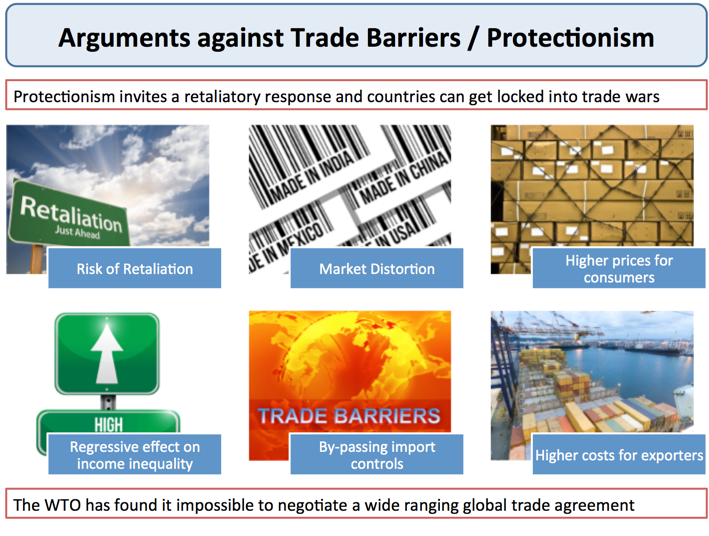
What are the main economic and social arguments against trade protectionist policies?
  1. Market distortion and loss of allocative efficiency
  2. Higher prices for consumers: Tariffs push up the prices for consumers and insulate inefficient sectors from genuine competition. They penalise foreign producers and encourage an inefficient allocation of resources both domestically and globally.
  3. Reduction in market access for producers: Export subsidies depress world prices and damage output, profits, investment and jobs in many lower-income developing countries that rely on exporting primary and manufactured goods for their growth.: Protectionism can be an ineffective and costly means of sustaining jobs.

Loss of economic welfare: Tariffs create a deadweight loss of consumer and producer surplus. Welfare is reduced through higher prices and restricted consumer choice. The welfare effects of a quota are similar to those of a tariff – prices rise because an artificial scarcity of a product is created.Extra costs for exporters: For goods that are produced globally, high tariffs and other barriers on imports act as a tax on exports, damaging economies, and jobs, rather than protecting themRegressive effect on the distribution of income: Higher prices from tariffs hit those on lower incomes hardest, because the tariffs (e.g. on foodstuffs, tobacco, and clothing) fall on products that lower income families spend a higher share of their income.Production inefficiencies: Firms that are protected from competition have little incentive to reduce their production costs. This can lead to X-inefficiency and higher average costs.Trade wars: There is the danger that one country imposing import controls will lead to retaliatory action by another leading to a decrease in the volume of world trade. Retaliatory actions increase the costs of importing new technologies affecting LRAS. Students should mention game theory when discussing the risks of retaliation with countries embroiled in trade disputes.Negative multiplier effects: If one country imposes trade restrictions on another, the resultant decrease in trade will have a negative multiplier effect affecting many more countries because exports are an injection of demand into the global circular flow of income.Second best approach:Protectionism is a second best approach to correcting for a country's balance of payments problem or the fear of structural unemployment. Import controls go against the principles of free trade. In this sense, import controls can cause government failure.
Arguments against protectionism
Economic Nationalism
Economic nationalism describes policies to protect domestic consumption, jobs and investment using tariffs and other barriers to the movement of labour, goods and capital
The term gained a more specific meaning in recent years after several European Union governments intervened to prevent takeovers of domestic firms by foreign companies. In some cases, the national governments also endorsed counter-bids from compatriot companies to create 'national champions'. Such cases included the proposed takeover of Arcelor (Luxembourg) by Mittal Steel (India). And the French government listing of the food and drinks business Danone (France) as a 'strategic industry' to block potential takeover bid by PepsiCo (USA
Analysis of the effects of an import tariff on consumer welfare
The deadweight loss of welfare from an import tariff

Friday, 9 March 2018

International Trade is alive and kicking - Asia-Pacific trade deal signed by 11 nations

Click here to access a piece on the new trade bloc, renamed (in the absence of the US) the Comprehensive and Progressive Agreement for Trans-Pacific Partnership (CPTPP). 

Interesting discussion on who will be the winners and losers from this deal, always a good way to evaluate discussions on this topic

Sunday, 4 March 2018

International Trade & Protectionism - A new Trade War?

I could have picked one of many articles on the latest to come out of the White House. I hope you guys have been following what's going on. Click here to access a BBC piece on the implications of tariffs for both the USA and its trading partners.


Tuesday, 27 February 2018

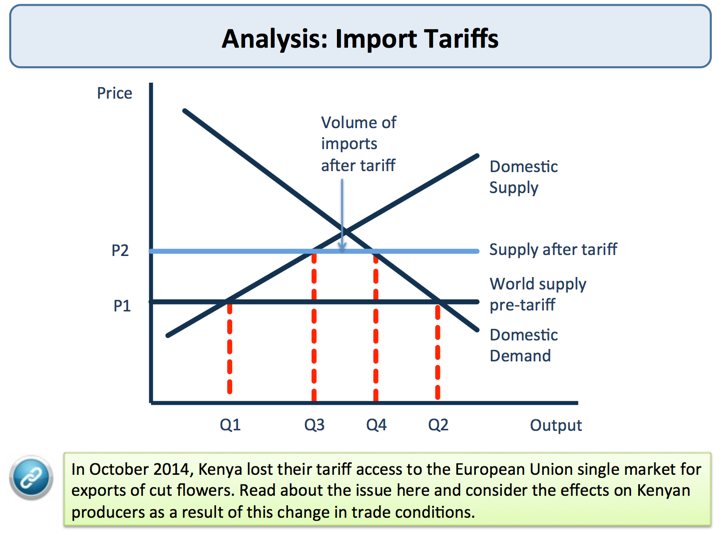
International Trade & Protectionism (Tariff Diagram Explained)

This short revision video takes you through the basic analysis diagram showing the effects of a tariff introduced into a domestic market.

Import tariffs are a form of protectionism.

Tariffs aim to protect domestic industries from overseas competition by increasing the relative price of imports, thereby causing a fall in import demand.

Thus a higher proportion of domestic demand will be met from domestic suppliers.

Tariffs can also generate tax revenues for the governments who levy tariffs. Indeed, for many lower and middle-income countries, import tariffs are an important source of tax revenues.

A reduction in the quantity of and total spending on imports as a result of the import tariff may also improve a nation’s trade balance.


Protectionism represents any attempt to impose restrictions on trade in goods and services
Some of the arguments put forward for protectionism
Examples of EU import tariffs by product
Trade disputes between countries happen because one or more parties either believes that trade is being conducted unfairly, on an uneven playing field, or because they believe that there is one or more economic or strategic justifications for import controls.
All countries operate with some forms of import controls
The aim is to cushion domestic businesses and industries from overseas competition and prevent the outcome resulting from the inter-play of free market forces of supply and demand.
Different forms of protectionism
  1. Tariffs - a tax or duty that raises the price of imported products and causes a contraction in domestic demand and an expansion in domestic supply. For example, until recently, Mexico imposed a 150% tariff on Brazilian chicken. The United States has an 11% import tariff on imports of bicycles from the UK.
  2. Quotas – these are quantitative (volume) limits on the level of imports allowed or a limit to the value of imports permitted into a country in a given time period. Until 2014, South Korea maintained strict quotas on imported rice. It has now replaced an annual import quota with import tariffs designed to protect South Korean rice farmers. Quotas do not normally bring in any tax revenue for the government
  3. Voluntary Export Restraint – this is where two countries make an agreement to limit the volume of their exports to one another over an agreed time period. Sometimes this is enforced by a government for example the USA enforced VER on Japan during the late 1980s
  4. Intellectual property laws e.g. patents and copyright protection
  5. Technical barriers to trade including product labeling rules and stringent sanitary standards. These increase product compliance costs and impose monitoring costs on export agencies. Huge vertically integrated businesses can cope with these non-tariff barriers but many of the least developed countries do not have the some technical sophistication to overcome these barriers.
  6. Preferential state procurement policies – this is where a government favour local/domestic producers when finalizing contracts for state spending e.g. infrastructure projects or purchasing new defence equipment
  7. Export subsidies - a payment to encourage domestic production by lowering their costs. Soft loans can be used to fund the dumping of products in overseas markets. Well known subsidies include Common Agricultural Policy in the EU, or cotton subsidies for US farmers and farm subsidies introduced by countries such as Russia. In 2012, the USA government imposed tariffs of up to 4.7 per cent on Chinese manufacturers of solar panel cells, judging that they benefited from unfair export subsidies after a review that split the US solar industry.
  8. Domestic subsidies – government help (state aid) for domestic businesses facing financial problems e.g. subsidies for car manufacturers or loss-making airlines.
  9. Import licensing - governments grants importers the license to import goods.
  10. Exchange controls - limiting the foreign exchange that can move between countries – this is also known as capital controls
  11. Financial protectionism – for example when a national government instructs banks to give priority when making loans to domestic businesses
  12. Murky or hidden protectionism - e.g. state measures that indirectly discriminate against foreign workers, investors and traders. A government subsidy that is paid only when consumers buy locally produced goods and services would count as an example. Deliberate intervention in currency markets might also come under this category.
Quotas, embargoes, export subsidies and exchange controls are examples of non-tariff barriers
Examiner’s tip: the tariff is frequently examined. Ensure that you can analyse the removal as well as the imposition of a tariff.

Tuesday, 23 January 2018

International Trade - Trump imposes tarifs

Click here to access a recent BBC article on the rise of protectionism in the USA. The US has approved controversial tariffs on imported washing machines and solar panels.
The move is in line with President Donald Trump's "America First" trade policy, which aims to protect local manufacturers from foreign competition.
Useful when discussing the relative merits of free trade Vs protectionism.
Who are the winners and losers in both the short and the long term?
What will be the impact on world trade and world GDP?

Wednesday, 1 April 2015

Unit 4: Two Articles for the price of one!

Thank you to Carys for this article on the UK current account. Really useful in explaining why we have a high deficit and also why it may not be that important....excellent evaluation on the question, 'Does a current account deficit matter'.

This second article comes straight from me. (Click here) The end of milk quotas is linked to protectionism, free trade, comparative advantage.

Please take some time to read them....and other articles as well.

Saturday, 8 June 2013

Unit 4: Protectionism and development


All, just thought I'd share an e mail I sent Gabriele to answer the question about how prtectionism can help increase efficiency of firms......

the argument about protectionism increasing efficiency is a valid one. It suggests that (for example) the protection of infant industries allows firms to increase investment without damaging competition hurting their profits.

This is an argument for development as well. ie increase barriers, invest in infrastructure and capital...become competitive, lower barriers......trade :-)
Obviously, the big issue is where do you get cash from in first place? Difficult to get IMF loans, cos they will say, only if you lower barriers!


Thursday, 6 June 2013

Unit 4: China, EU, Dumping & Protectionism

As I posted a few days ago, the Solar Panel argument was just the start of what could be a damaging trade war between China & the EU. This is a story where both superstates will lose out.

Demand for wine in China has surged in recent years, making it a key global wine market
Last month, the Chinese government warned the EU that it would "take necessary steps" to defend its national interests, if any duties were levied against its goods. Well, today they did just that, accusing the French of 'Dumping' wine into China!


Observers suggested that Beijing's latest move was a direct consequence of the EU decision.

"This might represent retaliation to what happened yesterday," Davide Cucino, president of the European Union Chamber of Commerce in Beijing, told the BBC.

"There is no interest for both actors to play the protectionism card, and frankly speaking retaliation represents a missed opportunity for China to provide the necessary evidence… in order to carry out a resolution to the photovoltaic case."

Click here to access the full article.

Wednesday, 5 June 2013

Unit 4: Protectionism & Dumping - so it begins!

So, the European Union has announced that it is to impose anti-dumping levies on imports of Chinese Solar panels, in a move that could trigger a damaging trade war between two of the world largets economies.

Click here for the full article. What might the economic effects of this increase in protectionism be on the two economies?