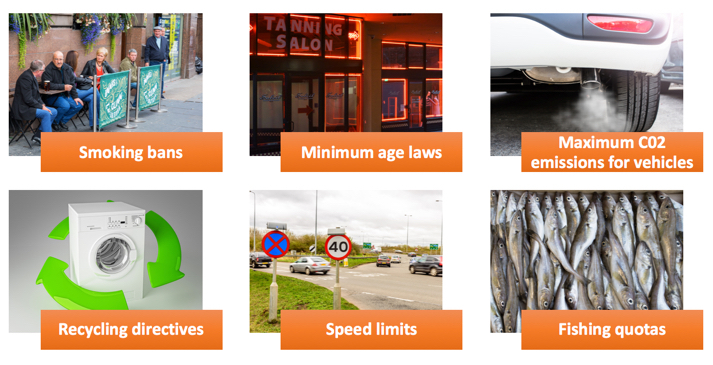
Examples include:
- Laws on minimum age for buying cigarettes and alcohol
- The Competition Act which penalizes businesses found guilty of price fixing cartels
- Statutory national minimum wage
- A new law in Scotland banning under-18s from using sun-beds
- Equal Pay Act and acts preventing other forms of discrimination
- Changes in the law on cannabis
- Maximum CO2 emissions for new vehicles, laws which restrict flight times at night
- Government appointed utility regulators who may impose price controls on privatized monopolists e.g. telecommunications, the water industry
The economy operates with a huge and growing amount of regulation. The government appointed regulators who can impose price controls in most of the main utilities such as telecommunications, electricity, gas and rail transport.
Free market economists criticize the scale of regulation in the economy arguing that it creates an unnecessary burden of costs for businesses – with a huge amount of "red tape" damaging the competitiveness of businesses.
Regulation may be used to introduce fresh competition into a market – for example breaking up the existing monopoly power of a service provider. A good example of this is the attempt to introduce more competition for British Telecom. This is known as market liberalization.
Problems that regulators of markets / industries can face
- Hard to find evidence of anti-competitive behaviour:
- Lack of spoken or written evidence
- Conflicting or asymmetric information
- Complex information
- Conflicting evidence – e.g. it might be markets forces or collusion in an oligopoly
- Fear of fines or other control mean that there is strong incentive to conceal collusion
- Lack of regulator power and lack of regulator resources
Revision Video: Evaluating Government Intervention in Markets


