Total Pageviews

Showing posts with label Government Failure. Show all posts

Thursday, 15 November 2018

Regulations (Government Intervention)

Regulations are a form of government intervention in markets - there are many examples we can use:


Examples include:
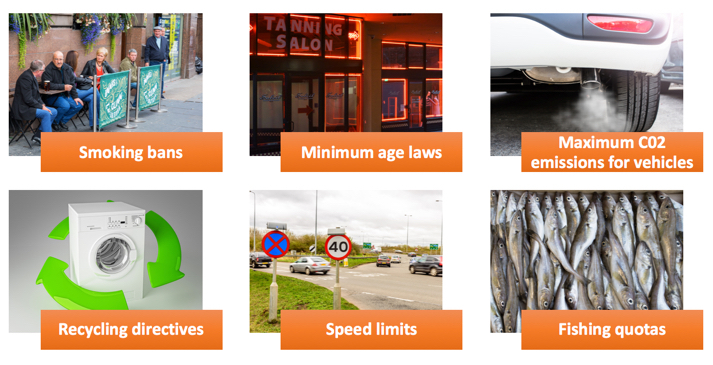
  • Laws on minimum age for buying cigarettes and alcohol
  • The Competition Act which penalizes businesses found guilty of price fixing cartels
  • Statutory national minimum wage
  • A new law in Scotland banning under-18s from using sun-beds
  • Equal Pay Act and acts preventing other forms of discrimination
  • Changes in the law on cannabis
  • Maximum CO2 emissions for new vehicles, laws which restrict flight times at night
  • Government appointed utility regulators who may impose price controls on privatized monopolists e.g. telecommunications, the water industry
The economy operates with a huge and growing amount of regulation. The government appointed regulators who can impose price controls in most of the main utilities such as telecommunications, electricity, gas and rail transport.
Free market economists criticize the scale of regulation in the economy arguing that it creates an unnecessary burden of costs for businesses – with a huge amount of "red tape" damaging the competitiveness of businesses.
Regulation may be used to introduce fresh competition into a market – for example breaking up the existing monopoly power of a service provider. A good example of this is the attempt to introduce more competition for British Telecom. This is known as market liberalization.
Problems that regulators of markets / industries can face
  1. Hard to find evidence of anti-competitive behaviour:
    • Lack of spoken or written evidence
    • Conflicting or asymmetric information
    • Complex information
    • Conflicting evidence – e.g. it might be markets forces or collusion in an oligopoly
  2. Fear of fines or other control mean that there is strong incentive to conceal collusion
  3. Lack of regulator power and lack of regulator resources

Revision Video: Evaluating Government Intervention in Markets


Thursday, 1 November 2018

UAE Tax - Law of unintended consequences

Thanks to Mr Wakerley for finding this article on illegal cigarettes in the UAE. Click here fore the link.


Wednesday, 31 October 2018

Regulation, Government Failure - Price Capping & ineffective regulation

This is a big topic these days. Governments try to intervene in markets in many ways, sometimes with success, others causing bigger issues. Below is a few presentations, videos, notes on the topic.

We will be going through in class.

Regulation and externalities:


Examples include:
  • Laws on minimum age for buying cigarettes and alcohol
  • The Competition Act which penalizes businesses found guilty of price fixing cartels
  • Statutory national minimum wage
  • A new law in Scotland banning under-18s from using sun-beds
  • Equal Pay Act and acts preventing other forms of discrimination
  • Changes in the law on cannabis
  • Maximum CO2 emissions for new vehicles, laws which restrict flight times at night
  • Government appointed utility regulators who may impose price controls on privatized monopolists e.g. telecommunications, the water industry (see later)
Regulation and Monopoly

The main aims of competition policy are to promote competition; make markets work better and contribute towards improved efficiency in individual markets and enhanced competitiveness of UK businesses within the European Union (EU) single market.
Competition policy aims to ensure
  • Technological innovation which promotes dynamic efficiency in different markets
  • Effective price competition between suppliers
  • Safeguard and promote the interests of consumers through increased choice and lower price levels


There are four key pillars of competition policy in the UK and in the European Union
  1. Antitrust & cartels: This involves the elimination of agreements that restrict competition including price-fixing and other abuses by firms who hold a dominant market position (defined as having a market share in excess of forty per cent)
  2. Market liberalisation: Liberalisation involves introducing competition in previously monopolistic sectors such as energy supply, retail banking, postal services, mobile telecommunications and air transport
  3. State aid control: Competition policy analyses state aid measures such as airline subsidies to ensure that such measures do not distort the level of competition in the Single Market
  4. Merger control: This involves the investigation of mergers and take-overs between firms (e.g. a merger between two large groups which would result in their dominating the market)
Main Roles of the Regulators
  • Regulators are the rule-enforcers and they are appointed by the government to oversee how a market works and the outcomes that result for producers and consumers
  • The main competition regulator in the UK is the Competition and Markets Authority (CMA)
Examples of competition policy in action
  • De-regulation - laws to reduce monopoly power
    • Preventing mergers/acquisitions that create a monopoly
    • Laws to introduce competition into the postal services industry
    • Forced sales of assets e.g. BAA and airports in the UK
  • Privatisation - transferring ownership
    • Stock market floatation of the Royal Mail
    • Part-privatisation of Network Rail similar to the sell-off of HS1 - the high-speed link that connects London's St Pancras to the Channel tunnel, on a long-term concession
  • Tough laws on anti-competitive behaviour
    • Strong laws and penalties against proven cases of price fixing or collusion that involves market sharing
    • Companies breaching EU and UK competition rules risk hefty fines of up to 10 per cent of global turnover - senior executives can be jailed
  • Reductions in import controls
    • A reduction in import tariffs encourages cheaper products from overseas
    • Increasing or eliminating import quotas can also have the same effect
    • Allowing new countries into the European Union single market increases contestability
  • Price controls: The government appointed regulators can also impose price capping formula in most of the main utilities such as telecommunications, electricity, gas and rail transport. (this is due to natural monopoly element of these industries)

Regulation may be used to introduce fresh competition into a market – for example breaking up the existing monopoly power of a service provider. A good example of this is the attempt to introduce more competition for British Telecom. This is known as market liberalization.


Free market economists criticize the scale of regulation in the economy arguing that it creates an unnecessary burden of costs for businesses – with a huge amount of "red tape" damaging the competitiveness of businesses.


Problems that regulators of markets / industries can face
  1. Hard to find evidence of anti-competitive behaviour:
    • Lack of spoken or written evidence
    • Conflicting or asymmetric information
    • Complex information
    • Conflicting evidence – e.g. it might be markets forces or collusion in an oligopoly
  2. Fear of fines or other control mean that there is strong incentive to conceal collusion
  3. Lack of regulator power and lack of regulator resources

Monday, 23 October 2017

Minimum Pricing Scheme: Alcohol in the UK

Click here to access an interesting piece on new legislation on the pricing of alcohol in Wales. Lots of economics here, including:

Market Failure
Externalities
Government intervention
Government failure
Impact on different demographics

Is this the way forward? How would you tackle the issue?

Saturday, 21 October 2017

Traffic jams and market failure

Click here to access a recent piece in the Guardian about congestion in the UK. It is a real problem with estimates of cost to the economy in the billions!
Classic example of market failure, government failure, opportunity cost, scarce resources, you name it....

Monday, 28 November 2016

Theme 1: Government Failure & Public Goods

Two presentations that link government failure and the provision of public goods.

Wednesday, 2 March 2016

Unit 1: Government Failure - The War on Drugs

A controversial, but relevant example of government failure. A concept that comes up every year in Unit 1 questions. Obviously it is very unlikely you will get a question on drugs, but the concepts are the same. Government intervening in a market to reduce market failure, but actually making things much worse!

Sunday, 5 January 2014

Unit 1: Market Failure & Government Failure in one go!

A really useful clip from last night's Channel 4 News highlights both issues - and points you towards the welfare implications of both. This would make a lovely example for any of you facing examination questions which are asking for an evaluation of government intervention in the market. 


In the first place, if the pharmaceutical companies are provided imperfect information, how might this affect market outcomes? And if there is an adverse effect, is there a case for government intervention? 

How would you both justify this, but equally, how might you oppose intervention?

Secondly, to what extent does spending £500m on Tamiflu represent a government failure? How would you define this? And how might it apply in this case. This is all thought-provoking stuff, I hope.

Wednesday, 19 December 2012

Unit 1: House Prices, Rent Controls and Labour Market Mobility

Labour Market Mobility refers to how easily people, or employees can move around in search of a job. Several factors prevent people from moving around freely, the skills and qualifications they possess is one thing. A lack of transferable skills acts as a barrier - if a worker is trained as a hairdresser they can not apply for jobs as an accountant for example. This is know an occupational immobility. Training and education can reduce occupational mobility but can be expensive and there is a time lag involved.

Geographical mobility is the ability of labour to freely move around in search of a job. In theory workers in the EU are free to work in any member country. In practice there are lots of barriers preventing people from moving to different countries. Family ties to a particular area often limit people in their search for jobs. 

Another factor that makes moving to different parts of a country in search of a job is house prices. House price in London and the South East are often much higher than in other parts of the country as shown below.


(www.tutor2u.com)

The demand for property increases for a number of reasons: Interest rates, consumer confidence, wages levels all affect house prices. Another interesting factor affecting house prices is immigration. Increased immigration increases the demand for houses, which pushes up the price. Citing immigration as a cause of increased house prices has lead to much debate in the UK. Political instability in the Middle East has lead to an increase in house prices in Dubai - people are moving from countries such as Syria to Dubai. Watch and read these links for more information:

Link 1
Video
Link 2
Link 3


Rising property prices as we looked at earlier can lead to factor immobility and market failure. There are often calls for the government to intervene and regulate the market. Have a read of this article HERE for more information.

Another method used to resolve factor immobility is rent controls. Tutor2U have created a revision presentation on the impact of rent controls.


Monday, 5 December 2011

Unit 1: Market Failure Vs Government Failure

One of the most prominent economists of the 20th century was the late Milton Friedman, an ardent free market supporter who remained skeptical of government’s ability to correct market failures through interventionist policies.


I found the talk below interesting. Friedman offers several examples of market failures that have been pointed to as a justification for government intervention, and argues that in fact, government often does not truly know what the right outcome is in most cases. He believes that government failure should be just as much a concern as market failure; and that therefore societal welfare would be best met by finding market-based solutions to the misallocation of resources that sometimes arises under conditions in which externalities exist.

As you watch the video, consider Friedman’s claims regarding the role of government, then post your response to one of the discussion questions below.


Discussion Questions:


1.Is government better able to know the “optimal” quantity of output of different goods and services than private individuals are?

2.Under what conditions would the free market be best able to achieve solutions to market failures such as those described by Friedman?

3.What do you think should be of greater to concern to society, market failure or government failure?