Total Pageviews

Sunday, 11 January 2015

Unit 3: Price capping - Rail fairs to rise by 2% in 2015.

Average rail fares will rise by 2.2% from 2 January, the rail industry has said, marking the lowest rise for five years.
In September, the government said regulated rail fare rises would be pegged to July's measure of Retail Price (RPI) inflation rather than capped at RPI plus 1%.
Click here to read the article. 

Saturday, 10 January 2015

Unit 3: Tesco, Coke and diseconomies of scale

This week we have read news of two corporate giants taking strides to rein in their operating costs amidst challenging business conditions. 


2014 was an annus horribulus for Tesco  as the grocery giant battled a string of profit warnings, declining like-for-like sales and the controversies surrounding mis-reporting of profits. Their new CEO has announced the shelving of many new larger stores, the closure of others (including those built but never opened) and the disposal of non-core assets such as Blinkbox. 

The final dividend to shareholders has been dropped in a bid to build up a larger buffer stock of cash. It is a classic example of a business that has grown too large; an unwieldy business facing severe competition from the fast-growing deep discounters such as Aldi and Lidl.


Coca Cola has also announced well over a thousand job cuts in the wake of sluggish revenue growth and declining profits. I was staggered to read that they employ over 130,000 people worldwide!

Thursday, 8 January 2015

Unit 4: Deflation in Eurozone countries

There is so much going oin in the world of economics at the moment. Latest figures show that the Eurozone, as predicted, now has deflation. 

The tip into deflation adds pressure on the European Central Bank (ECB) to take further action to stimulate the bloc's economy.

Click here for the BBC article.


Unit 2 & 4: More data on Russia - excellent application to theory

The recession and currency crisis in Russia provides plenty of material for both AS and A2 students to get their teeth stuck into.

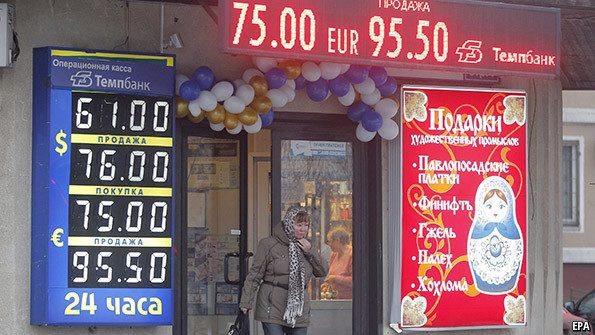
AS students could consider the inflationary effects of the plummeting rouble. With inflation at 9.1% and "Russian shopkeepers re-pricing their goods daily" it provides an excellent real world example of what is often referred to in textbooks as menu-costs. 

With the rouble depreciation nearly 50% against the dollar in a matter of weeks it is also a useful example of imported inflation, pushing food price inflation to over 30%, which is eroding the living standards of the majority of working Russians.

A2 students could look at the attempts of the central bank to defend the currency. A 6.5 percentage point increase at 1am on the 16th December took the interest rate to 17%, a 12.5 point increase from the start of the year. 

Russia has also spent some $80bn dollars in 2014 defending the value of the currency. 

The initial effects of he rate rise was indeed to strengthen the rouble but the gains were eroded and reversed by the end of the day. Lots of interesting discussions to be had about what drives currency movements.

There is also plenty of discussion about Russia's debt, both dollar-denominated and rouble-denominated. The ability of Russia pay back $115bn of dollar debt which is due in 2015 is increasingly being called into questions as the rouble depreciates. 

This is obviously not just a Russian specific issue, the elections in Greece and the potential 'Grexit' could put Greece's euro-denominated debts under huge pressure.

All this is without even mentioning oil prices. Brent crude oil traded at $50 yesterday, a fresh low.

Monday, 5 January 2015

Unit 4: The Economic Hitmen!

I found it....great clip which highlights the issues that foreign aid and FDI can have on developing countries. If you get chance, read the book!

Sunday, 4 January 2015

Unit 4: Inflation in Russia - depreciating Rouble

Click here to access an article looking at the opposite problem to the Eurozone, in Russia. Whereas the Eurozone is worried about deflation, Russia's issue is inflation!

Another excellent up to date example of how the currency can affect the rest of the economy.

What are the options for the Russian government?
Is it another example of primary product dependency causing havoc for the rest of the economy?


Saturday, 3 January 2015

Unit 2 & 4: Monetary Policy in the Eurozone.


Draghi comments send Euro to lowest level since 2010


Click here to read an interesting article regarding monetary policy in the Eurozone. There is lots in it for macro economics students.

Not least:

Monetary Policy
Quantitive easing
Exchange Rate
Deflation

Make sure you understand the link between all of the above concepts. Please discuss with your teacher.