Here are the slides and videos from our revision webinar covering some aspects of Brexit relevant to A level economics students. In particular there is a focus on synoptic connections to micro and macro consequences.
The EU, taken as a whole is the UK’s largest trading partner. In 2016, UK exports to the EU were £236 billion (43% of all UK exports). UK imports from the EU were £318 billion (54% of all UK imports).
The UK had an overall trade deficit of £82 billion with the EU in 2016. A surplus of £14 billion on trade in services was outweighed by a deficit of £96 billion on trade in goods.
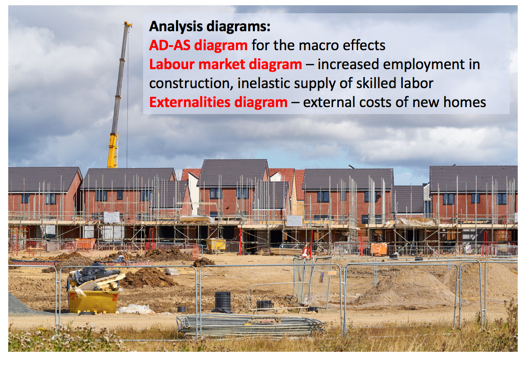
In this video we look at building an answer to a synoptic 25 mark essay question on the micro and macro effects of an increase in house-building in the UK economy. Once again, this could be a synoptic question and therefore would require both micro and macro analysis.
Micro point 1
An increase in new house-building will lower prices and therefore help to make property more affordable for home-buyers.
For example, eliminating VAT on building new homes on brownfield sites reduces costs for building firms and therefore make it more profitable to construct new homes. An increase in supply can bring down prices for home-buyers if the number of new homes exceeds the increase in demand for property.
Whether prices fall and makes housing more affordable depends on the other costs of building homes. The construction industry might be affected by skills shortages which leads to higher wage costs or higher costs caused by tougher building regulations such as meeting emissions targets.
Micro point 2
Increased house-building may lead to environmental damage which could then be a cause of market failure.
Building new homes can lead to external costs in the form of noise pollution and waste products. Building hundreds of new homes in a local area might negatively affect people already living there and lead to increased congestion on roads.
However a counter argument is that the local authority might insist on construction companies spending money on improving roads and also building new facilities for the local community as part of the planning process.
Macro point 1
Policies that successfully increase the rate of new house-building will help to stimulate UK economic growth in both the short and the long run.
This is because investment in new housing is a component of aggregate demand and is likely to lead to a strong multiplier effect as building is a labour-intensive industry. More homes also increases the geographical mobility of labour which will help to reduce the rate of unemployment in the longer term.
The size of the multiplier effect depends on whether the building industry is able to expand their labour force. They may face skills shortages which leads them to use workers who have migrated from overseas. Their remittances sent home would be a leakage from the circular flow of income.
Macro point 2
An increase in house-building will lead to a rise in government tax revenues which will help to bring down the fiscal deficit.
House-building companies will make more profits when new homes are sold and pay more corporation tax. More houses will also be bought and sold leading to an increase in revenue from Stamp Duty and VAT on building/DIY materials.
This macro effect depends on the extent to which building homes is actually profitable. Building firms might face higher costs (e.g. imported raw materials) which lowers the rate of return and cuts corporation tax liability.
Final reasoned comment:
There is substantial unmet demand for housing in the UK and a rise in new house-building is likely to provide significant micro and macro benefits. But the government needs to maintain a balance between homes available to buy and those offered for rent since new homes are unaffordable for many people.
Opportunities for analysis diagrams in this question
Tutor2u are now producing a series of model essay plans for 25 mark essays. I will publish them all on this blog. Just search essay plans and they will pop up....
This one is on Steel tariffs and would be on the synoptic paper 3.
Micro point 1
One micro effect of a tariff on Chinese steel is that steel manufacturing firms in the UK will see an increase in demand and improved profits from selling output.
This is because an import tariff makes Chinese steel more expensive which can lead to expenditure-switching effects. Users of steel such as construction firms may substitute towards relatively cheaper UK steel leading to an outward shift of demand and a higher supernormal profit per tonne of steel supplied.
However the strength of the substitution effect depends on the size of the import tariff because Chinese steel might have been significantly cheaper than the UK. It also depends on whether there is a compensating change in the exchange rate e.g. a devaluation of the Yuan against the £ sterling.
Micro point 2
A second micro effect of a tariff on Chinese steel is that the UK steel industry may become less contestable.
Import tariffs are barriers to trade and they make it harder for imports to compete with domestic suppliers. Weaker import competition increases the monopoly power of UK producers and might lead to both allocative and productive inefficiency.
A counter-argument is that the dumping of cheap steel at a price below cost into the UK by Chinese suppliers is itself an attempt to weaken market competition and give Chinese firms more monopoly power in the long run.
Macro point 1
A macro effect of a tariff on steel is that the policy will help to prevent a rise in structural unemployment in regions where steel-making is a key industry.
The closure of loss-making steel plants creates structural unemployment because workers in these factories often have specific skills that are not fully transferable to other jobs. Workers therefore suffer from occupational immobility. Rising unemployment can then lead to a negative multiplier effect.
A critique of this point is that a tariff does not address the long-term problems of low productivity and higher unit costs in the UK steel industry. Occupational immobility might be better addressed with a significant increase in government investment in training programs.
Macro point 2
A 2nd macro effect of a tariff is that the current account of the balance of payments is likely to improve.
This is because a tariff increases prices and therefore reduces the quantity of imports bought which then leads to a fall in spending on imports. UK steel makers will be able to supply a higher percentage of total market demand for steel.
However, many other industries use steel and will be affected by the tariff. For example, car makers will see rising costs which might make them less price competitive in overseas markets leading to a possible decline in UK exports.
Diagram opportunities for analysis marks
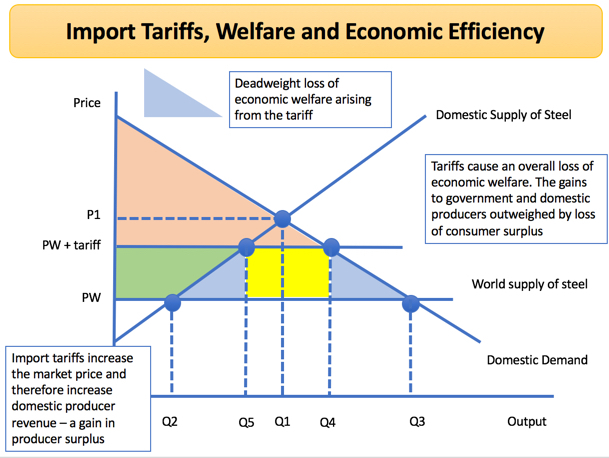
Tariff diagram – showing rise in imported steel price, changes in domestic demand and supply
Welfare diagram – e.g. impact of a tariff on consumer and producer surplus
AD-AS diagram - Rising import costs causing an inward shift of SRAS
This is excellent for all Economists, both Y11 and Sixth Form!
Supply-side policies are mainly micro-economic policies aimed at making markets and industries operate more efficiently and contribute to a faster underlying-rate of growth of real national output.
Brief Video Introduction to Supply Side Policies
Successful policies have the effect of shifting the LRAS curve to the right leading to a rise in potential output
Most governments believe that improved supply-side performance is the key to achieving sustained growthwithout causing a rise in inflation.
Supply-side reform on its own is not enough to achieve this growth. There must also be a high enough level of AD so that the productive capacity of an economy is actually brought into play.
Supply-side policies can be implemented by the public or the private sector
Evaluating supply-side policies
Supply-side objectives
Key concepts to focus on are incentives, enterprise, technology, mobility, flexibility and efficiency.
1.Improve incentives to look for work and invest in people’s skills
2.Increase labour and capital productivity
3.Increase occupational and geographical mobility of labour to help reduce the rate of unemployment
4.Increase investment and research and development spending
5.Promoting more competition and stimulate a faster pace of invention and innovation to improve competitiveness
6.Provide a platform for sustained non-inflationary growth
7.Encourage the start-up and expansion of new businesses / enterprises especially those with export potential
8.Improve the trend rate of growth of real GDP
Some key supply-side challenges for the UK economy
Market-based supply-side policies
1.Cutting government spending and borrowing
2.Lower business taxes to stimulate investment and lower income taxes to improve work incentives
3.Reducing red-tape to cut the costs of doing business
4.Measures to improve the flexibility of the labour market / reforming employment laws
5.Policies to boost competition such as deregulation and tough anti-monopoly and anti-cartel laws
6.Privatisation of state assets (selling off public sector businesses into the private sector)
7.Opening up an economy to overseas trade and investment
Interventionist policies
1.State has key role in investing in public services and building critical infrastructure
2.Tax incentives and welfare reforms can encourage more people into work
3.A commitment to a fair minimum wage / living wage to improve work incentives
4.Active regional policy to boost under-performing areas / areas of high unemployment
5.Some case for selective import controls to allow domestic industries to expand
6.Management of the exchange rate to improve competitiveness of export industries
7.Nationalisation of some key industries
8.Stronger regulation of industries
Recent UK Government Supply-Side Policies
Relaxation of the Sunday trading laws – but worries over work-life balance
24 new regional enterprise zones – aiming to take advantage of external economies of scale by attracting inward investment
Completion of London’s Cross Rail – with plans for Cross Rail 2 and HS3 (East-West high speed rail in North of England)
Tax relief for businesses investing in low carbon technologies – designed to increase investment in renewable energy capacity
Increases in the income tax free allowance to £11,000 a year
Reduction in taper rate at which universal benefit is taken away as people earn extra income from 65% to 63% - helps work incentives
Main rate of corporation tax (a tax on profits) - currently 20% - to fall to 17% by 2020 – designed to stimulate domestic I and FDI
UK National Infrastructure Plan – range of projects including the new nuclear power station at Hinkley Point in Somerset
Planned investment of £400m in 'full-fiber' super-fast broadband
£2.3 billion for a new Housing Infrastructure Fund – i.e. investment in improved road and water connections to support new housing